Question 9
A problem is well posed in specified function spaces if solutions exist, are unique, and depend continuously on the prescribed data. To examine the third requirement, consider the Cauchy data problem with . Measure the bottom data by on and the observed solution by . For integers , set
Tasks
Verify the PDE and side conditions and find the exact bottom data .
Compute the bottom data norm and top solution norm. Determine their limits as .
Prove that the amplification ratio is unbounded and explain why the calculation rules out a continuous solution map at zero in the stated norms if the problem is uniquely solvable on a linear class containing these fields.
Explain why convergence of to zero does not rescue continuity. Rescale the fields to obtain data converging to zero while the top norm stays exactly one, and sketch the vertical amplitude profiles for three .
Show solutionHide solution
Question 9 – Solution
Strategy. Small absolute outputs are not enough for stability; compare their size with the much smaller input, then normalize.
Step 1: Verify the supplied solutions. Two derivatives multiply by ; two derivatives multiply it by . Their sum is zero, and vanishes on both sides. At the bottom, . These are smooth fields with compatible side and bottom values.
Step 2: Measure the input and output. For each integer , . Hence the bottom norm is and the top norm is Both tend to zero. Thus this sequence by itself does not contradict continuity; the relative amplification is the information needed for the next step.
Step 3: Expose unbounded amplification. The ratio is . If uniqueness holds in a linear solution class containing these fields, solving the homogeneous linear PDE with data is a linear map. A continuous linear map between the stated normed spaces must obey a uniform bound on its domain. The unbounded ratios rule out that bound. No existence or uniqueness theorem for arbitrary Cauchy data has been assumed.
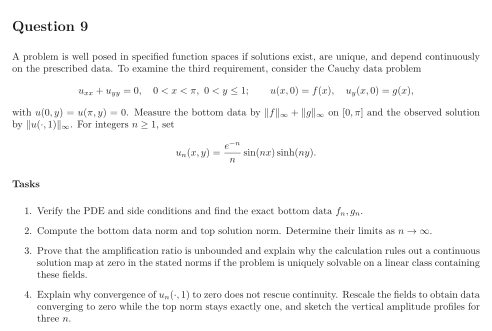
Step 4: Give a direct discontinuity sequence. Set . Its top norm is one, whereas its bottom norm is . The zero data have the zero solution; uniqueness would force the solution map to select these , contradicting continuity at zero. The vertical envelopes are , not solution traces at one fixed for every .
See the diagram in the original worksheet below.