Question 2
Seek nonzero separated solutions of on , , with and mixed endpoint conditions Use the convention , .
Tasks
Derive the endpoint conditions on . Use integration by parts to prove that every nonzero spatial factor has ; address equality explicitly.
Solve the spatial problem and list all eigenvalues and eigenfunctions, using an index . Explain why checking only a sine condition at both ends would give the wrong spectrum.
Find the time factor and compare the amplitude half-lives of the first two modes. Distinguish amplitude half-life from the half-life of squared amplitude.
Sketch the first three spatial factors normalized to have sine coefficient one, using . Locate their interior zeros and verify their right-end slopes.
Show solutionHide solution
Question 2 – Solution
Strategy. Let the actual boundary operators select the admissible separation constants.
Step 1: Prove positivity before solving the ODE. At a time where , the endpoint conditions give , . Multiplication by and integration yield If , then vanishes identically; forces . Thus a nonzero factor has ; negative values are impossible.
Step 2: Apply the two different endpoint conditions. Put . The general solution is . The left condition gives , and the right gives . For , The right condition is on the derivative, so it selects zeros of cosine. Using would impose an unrequested Dirichlet condition there.
Step 3: Compare decay measures. The modes are . Their amplitude half-lives are , so . Squared amplitude decays as and has half-life . Confusing those two quantities introduces a factor of two.
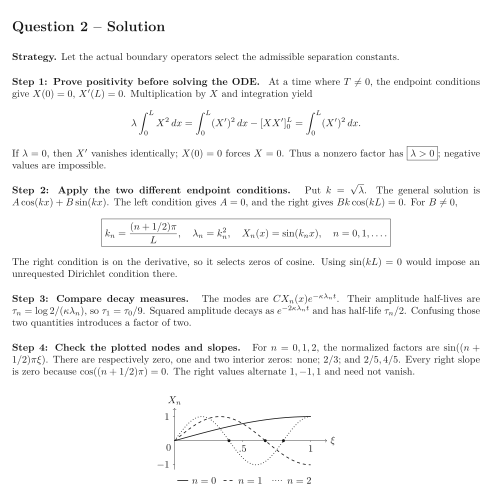
Step 4: Check the plotted nodes and slopes. For , the normalized factors are . There are respectively zero, one and two interior zeros: none; ; and . Every right slope is zero because . The right values alternate and need not vanish.
See the diagram in the original worksheet below.