Question 9
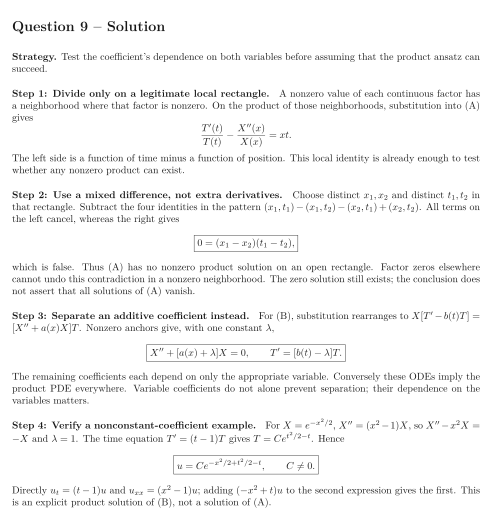
Consider smooth product candidates , neither factor identically zero, on an open rectangle , where each interval has positive length. Compare In (B), the given coefficient functions are smooth. No boundary data are imposed.
Tasks
Show that a nonzero product solving (A) would imply on some smaller open rectangle where both factors are nonzero.
Prove that this identity is impossible by comparing two positions and two times. Explain why zeros of the factors cannot avoid the contradiction.
Derive separated ODEs for (B), using . Explain how the additive coefficient structure permits separation even though the PDE has variable coefficients.
Take , . Construct a nonzero product with , determine and , and verify the resulting field directly in (B).
Show solutionHide solution
Question 9 – Solution
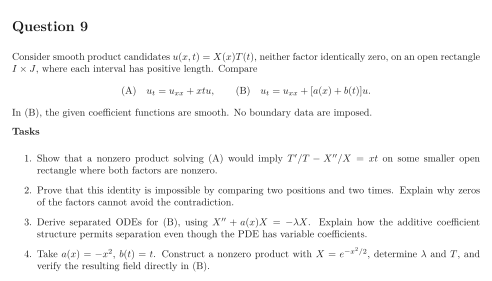
Strategy. Test the coefficient’s dependence on both variables before assuming that the product ansatz can succeed.
Step 1: Divide only on a legitimate local rectangle. A nonzero value of each continuous factor has a neighborhood where that factor is nonzero. On the product of those neighborhoods, substitution into (A) gives The left side is a function of time minus a function of position. This local identity is already enough to test whether any nonzero product can exist.
Step 2: Use a mixed difference, not extra derivatives. Choose distinct and distinct in that rectangle. Subtract the four identities in the pattern . All terms on the left cancel, whereas the right gives which is false. Thus (A) has no nonzero product solution on an open rectangle. Factor zeros elsewhere cannot undo this contradiction in a nonzero neighborhood. The zero solution still exists; the conclusion does not assert that all solutions of (A) vanish.
Step 3: Separate an additive coefficient instead. For (B), substitution rearranges to . Nonzero anchors give, with one constant , The remaining coefficients each depend on only the appropriate variable. Conversely these ODEs imply the product PDE everywhere. Variable coefficients do not alone prevent separation; their dependence on the variables matters.
Step 4: Verify a nonconstant-coefficient example. For , , so and . The time equation gives . Hence Directly and ; adding to the second expression gives the first. This is an explicit product solution of (B), not a solution of (A).