Question 3
For on with , zero endpoint values, and , take the continuous tent-shaped initial temperature Its height is one. You may use Fourier convergence for continuous piecewise smooth functions with zero endpoint values.
Tasks
Derive all sine coefficients by splitting the integral at , retaining the change in slope, and write the heat solution.
Justify the initial trace and positive-time smoothing even though jumps at .
Show how the location can be recovered from the ratio . State its allowed range and explain why the recovery is unique when .
For , , simplify the coefficients, identify the missing modes, and sketch the initial tent and the profiles at .
Show solutionHide solution
Question 3 – Solution
Strategy. The corner in the initial profile appears as a slope jump in the coefficient calculation, not as a failure of the positive-time heat solution.
Step 1: Compute the contribution of the slope jump. With , integration by parts once gives since vanishes at both endpoints. Using to the left and to the right gives Therefore
Step 2: Separate initial regularity from later regularity. Since , the sine series converges absolutely and uniformly, and Fourier convergence identifies its initial sum as the continuous tent. Summable domination gives uniform convergence to as . For every , polynomial factors from any finite number of derivatives are dominated by Gaussian decay for . Thus the series is smooth for positive time, satisfies the PDE termwise and retains zero endpoints. Its initial derivative jump does not persist as a corner in a positive-time profile.
Step 3: Recover the peak location from two modes. Put . Then and The ratio must lie strictly between and . Cosine is strictly decreasing on , so this reconstruction is unique in the stated family.
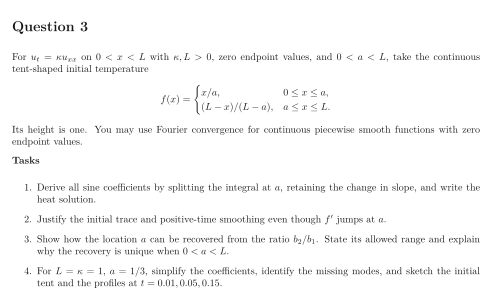
Step 4: Specialize and interpret the profiles. For , , . Exactly the multiples of three vanish, and recovers . The figure uses the exact piecewise initial trace and rapidly convergent positive-time series. The peak rounds as the profile diffuses toward zero.
See the diagram in the original worksheet below.