Question 9
For on with zero endpoint values, let be the orthonormal spatial modes. Write and , where . All norms in this question are norms.
Tasks
Relate and . Prove that there is at most one initial field for given exact final data, and state the precise coefficient condition for such an initial field to exist.
Use initial fields to show that uniqueness of backward reconstruction does not imply continuous dependence on final data in these norms.
Suppose measurement noise in the final field has norm at most . Reconstruct only modes and prove that the reconstructed noise has norm at most . Show that this bound is sharp.
For , , choose the largest integer certified to keep reconstructed noise below . Plot of modal amplification against integer mode number, and explain why controlling noise alone does not bound the omitted true initial modes.
Show solutionHide solution
Question 9 – Solution
Strategy. Each forward-decaying mode becomes an exponentially amplified mode when time is reversed.
Step 1: Characterize exact inversion. Forward evolution gives , so the only possible coefficients are . Completeness implies at most one initial field. It exists in exactly when Indeed this condition constructs an sine expansion whose forward solution has the given coefficients. Arbitrary final data need not satisfy this stronger condition.
Step 2: Disprove continuity despite uniqueness. Take , whose initial norm is one. Its final field has norm . Thus final data tend to zero while their uniquely determined initial fields do not. The backward map on its attainable-data domain is not continuous at zero in the stated norms. No contradiction arises with the stable forward problem, which damps these same modes.
Step 3: Bound noise after truncating the inverse. Let be the noise coefficients, so . The retained reconstructed noise satisfies Taking square roots gives the bound, attained by noise .
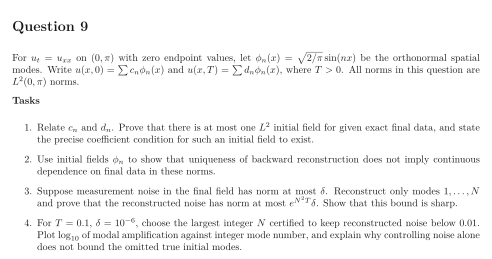
Step 4: Choose a noise cutoff and state its limitation. The requirement is , or . Thus is the largest certified integer: the bounds for are approximately and . The plot uses discrete stems, since is an integer; their heights are . The omitted initial tail has norm , for which no numerical bound was supplied. A noise cutoff controls amplification but requires additional prior information to control that approximation error.
See the diagram in the original worksheet below.