Question 2
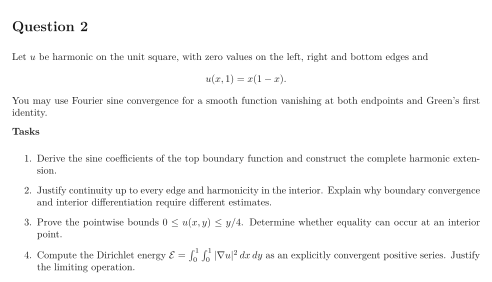
Let be harmonic on the unit square, with zero values on the left, right and bottom edges and You may use Fourier sine convergence for a smooth function vanishing at both endpoints and Green’s first identity.
Tasks
Derive the sine coefficients of the top boundary function and construct the complete harmonic extension.
Justify continuity up to every edge and harmonicity in the interior. Explain why boundary convergence and interior differentiation require different estimates.
Prove the pointwise bounds . Determine whether equality can occur at an interior point.
Compute the Dirichlet energy as an explicitly convergent positive series. Justify the limiting operation.
Show solutionHide solution
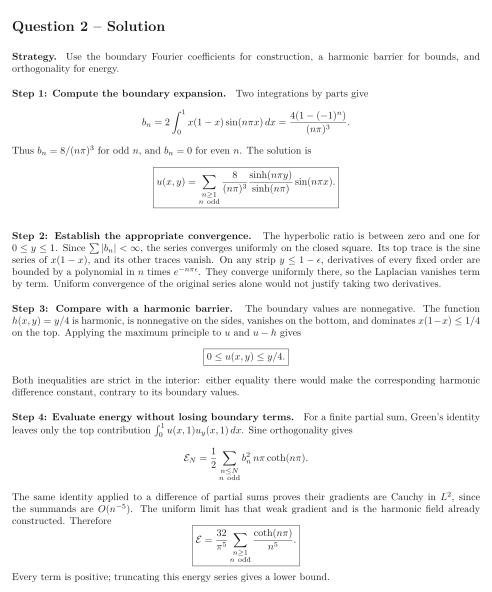
Question 2 – Solution
Strategy. Use the boundary Fourier coefficients for construction, a harmonic barrier for bounds, and orthogonality for energy.
Step 1: Compute the boundary expansion. Two integrations by parts give Thus for odd , and for even . The solution is
Step 2: Establish the appropriate convergence. The hyperbolic ratio is between zero and one for . Since , the series converges uniformly on the closed square. Its top trace is the sine series of , and its other traces vanish. On any strip , derivatives of every fixed order are bounded by a polynomial in times . They converge uniformly there, so the Laplacian vanishes term by term. Uniform convergence of the original series alone would not justify taking two derivatives.
Step 3: Compare with a harmonic barrier. The boundary values are nonnegative. The function is harmonic, is nonnegative on the sides, vanishes on the bottom, and dominates on the top. Applying the maximum principle to and gives Both inequalities are strict in the interior: either equality there would make the corresponding harmonic difference constant, contrary to its boundary values.
Step 4: Evaluate energy without losing boundary terms. For a finite partial sum, Green’s identity leaves only the top contribution . Sine orthogonality gives The same identity applied to a difference of partial sums proves their gradients are Cauchy in , since the summands are . The uniform limit has that weak gradient and is the harmonic field already constructed. Therefore Every term is positive; truncating this energy series gives a lower bound.