Question 4
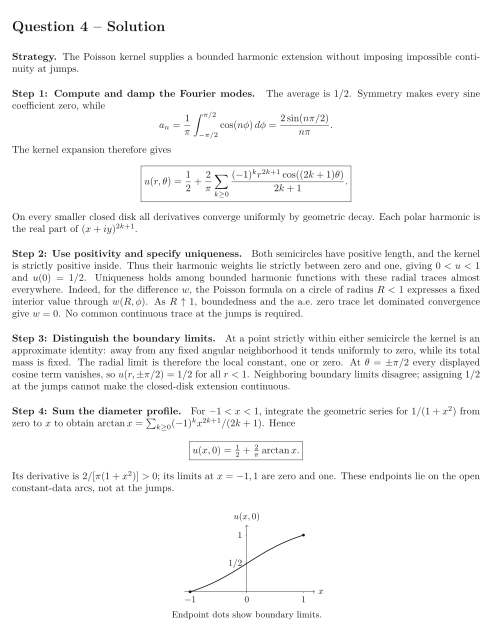
Inside the unit disk, seek the bounded harmonic extension of the boundary function Angles are interpreted modulo . Values assigned at the two jump points do not affect the Poisson integral You may use that this kernel is positive, integrates to , and has Fourier expansion .
Tasks
Compute the boundary Fourier coefficients and the resulting harmonic series.
Prove in the disk and find the center value. Explain the uniqueness class for these discontinuous data.
Determine the radial boundary limits on both open semicircles and at the two jump points. Explain why no continuous extension to the entire closed disk exists.
Find a closed expression for along the horizontal diameter and sketch it, including its limiting endpoint values.
Show solutionHide solution
Question 4 – Solution
Strategy. The Poisson kernel supplies a bounded harmonic extension without imposing impossible continuity at jumps.
Step 1: Compute and damp the Fourier modes. The average is . Symmetry makes every sine coefficient zero, while The kernel expansion therefore gives On every smaller closed disk all derivatives converge uniformly by geometric decay. Each polar harmonic is the real part of .
Step 2: Use positivity and specify uniqueness. Both semicircles have positive length, and the kernel is strictly positive inside. Thus their harmonic weights lie strictly between zero and one, giving and . Uniqueness holds among bounded harmonic functions with these radial traces almost everywhere. Indeed, for the difference , the Poisson formula on a circle of radius expresses a fixed interior value through . As , boundedness and the a.e. zero trace let dominated convergence give . No common continuous trace at the jumps is required.
Step 3: Distinguish the boundary limits. At a point strictly within either semicircle the kernel is an approximate identity: away from any fixed angular neighborhood it tends uniformly to zero, while its total mass is fixed. The radial limit is therefore the local constant, one or zero. At every displayed cosine term vanishes, so for all . Neighboring boundary limits disagree; assigning at the jumps cannot make the closed-disk extension continuous.
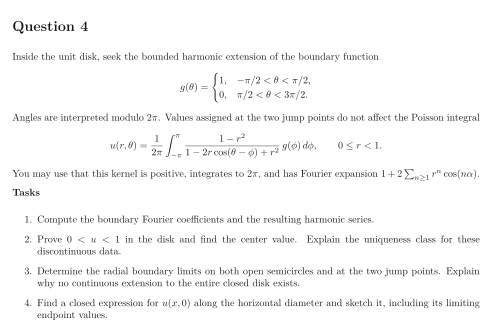
Step 4: Sum the diameter profile. For , integrate the geometric series for from zero to to obtain . Hence Its derivative is ; its limits at are zero and one. These endpoints lie on the open constant-data arcs, not at the jumps.
See the diagram in the original worksheet below.