Question 7
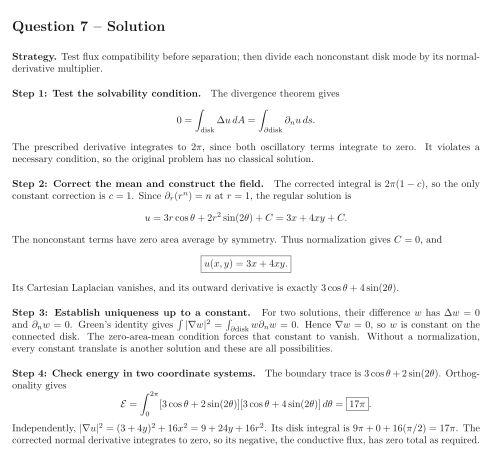
On the unit disk consider the Neumann problem Here is the outward normal derivative, not the outward conductive heat flux.
Tasks
Decide whether a classical solution exists. Derive the necessary compatibility condition and evaluate it for these data.
Subtract a constant from the prescribed derivative to make the data compatible. Find and construct a regular harmonic solution whose area average on the disk is zero.
Prove uniqueness under that normalization, and state precisely the nonuniqueness without it.
For the corrected solution, compute its boundary trace, Dirichlet energy and net conductive heat flux. Check the energy independently by integrating the Cartesian gradient.
Show solutionHide solution
Question 7 – Solution
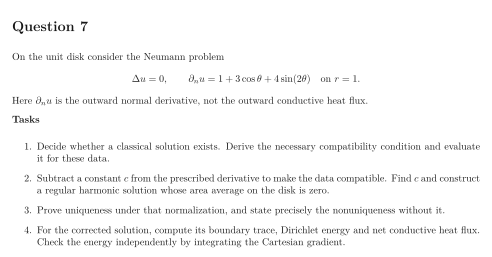
Strategy. Test flux compatibility before separation; then divide each nonconstant disk mode by its normal-derivative multiplier.
Step 1: Test the solvability condition. The divergence theorem gives The prescribed derivative integrates to , since both oscillatory terms integrate to zero. It violates a necessary condition, so the original problem has no classical solution.
Step 2: Correct the mean and construct the field. The corrected integral is , so the only constant correction is . Since at , the regular solution is The nonconstant terms have zero area average by symmetry. Thus normalization gives , and Its Cartesian Laplacian vanishes, and its outward derivative is exactly .
Step 3: Establish uniqueness up to a constant. For two solutions, their difference has and . Green’s identity gives . Hence , so is constant on the connected disk. The zero-area-mean condition forces that constant to vanish. Without a normalization, every constant translate is another solution and these are all possibilities.
Step 4: Check energy in two coordinate systems. The boundary trace is . Orthogonality gives Independently, . Its disk integral is . The corrected normal derivative integrates to zero, so its negative, the conductive flux, has zero total as required.