Question 2
A uniform string of length , tension and density has fixed endpoints and wave speed . It is plucked to height at , where , then released from rest: Use the finite-energy solution of .
Tasks
Derive the sine coefficients and the full solution. State in what sense the initial data and PDE are satisfied near the moving corners.
Set . Identify precisely which modes are absent and compute the initial, hence conserved, energy.
Prove and . Include the velocity state at these times.
Let be the odd, -periodic extension of . Use it to obtain exact piecewise-linear profiles at for , , and sketch them without truncating a Fourier series.
Show solutionHide solution
Question 2 – Solution
Strategy. Fourier coefficients reveal the missing harmonics, while reflected traveling profiles preserve the corners exactly.
Step 1: Compute the pluck coefficients. Integrating separately on and gives Thus The coefficients give uniform convergence of displacement. The initial velocity is zero in , and the solution has finite conserved energy. It solves the PDE weakly and classically away from the propagating slope corners; no globally solution is claimed.
Step 2: Identify the spectrum and energy. For , , so exactly the positive multiples of three are absent. Initially all energy is elastic: The finite-energy wave evolution conserves this value.
Step 3: Verify the reflected and full returns. At , each cosine is , and . Hence . At every cosine equals one, so . The modal velocities vanish at both times, giving zero velocity in .
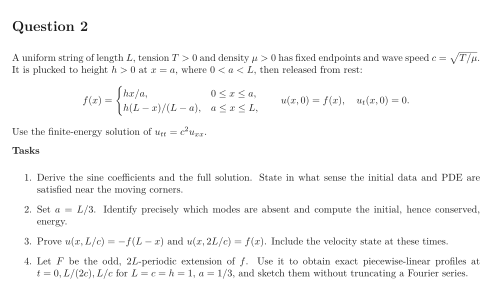
Step 4: Construct exact corner-preserving snapshots. The reflected d’Alembert form is . Oddness and periodicity enforce both endpoints and recover both initial data. For the stated numbers, the half-time profile is The other two profiles are and ; their corners are plotted at their exact positions.
See the diagram in the original worksheet below.