Question 4
A string of length has tension , density and speed . Its left end is fixed and its right end is free for : At release its displacement is , , and its velocity is zero. Interpret this as a finite-energy problem, since the initial slope need not satisfy the newly released end condition.
Tasks
Derive the mixed-end eigenfunctions, frequencies and coefficients of . Construct the solution.
Explain the initial corner incompatibility. Prove that the full state reverses sign after and has smallest positive period .
Show that at the string is flat but is not at rest. Find its velocity in the open interval and verify the conserved energy.
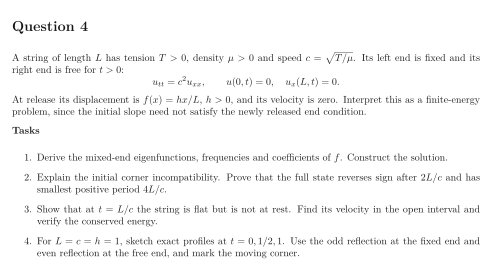
For , sketch exact profiles at . Use the odd reflection at the fixed end and even reflection at the free end, and mark the moving corner.
Show solutionHide solution
Question 4 – Solution
Strategy. A free end selects half-integer modes; the release launches a corner rather than making the initial slope compatible retroactively.
Step 1: Construct the mixed-mode solution. The conditions , give , , and . Since ,
Step 2: State the trace and recurrence precisely. Initially , so a solution with continuous at the release corner cannot satisfy the new free-end condition there. The displayed finite-energy solution recovers uniformly and zero initial velocity in ; its boundary condition has the usual weak/natural meaning at wavefront events. Every active frequency is an odd multiple of . Thus both and change sign after and return after . The nonzero lowest mode requires that full period, proving minimality.
Step 3: Resolve the flat but moving state. At every temporal cosine vanishes. For , Here for , the sine series of a constant on that interval. The fixed-end velocity remains zero; the interior velocity trace is an statement, not corner continuity. Initially . At this flat snapshot, the kinetic energy is , so the energy is unchanged.
Step 4: Follow the released-end corner. Extend oddly across zero and evenly across , with period , and take the average of its two translates. For the stated units and this gives For , the corner is at : the left part retains slope one and the right part is flat and moving downward. The snapshots below use exact line segments.
See the diagram in the original worksheet below.