Question 6
A unit string with unit tension and density has fixed ends and is initially at rest. A spatially sinusoidal force is held constant for a chosen duration : The indicator is one during the pulse and zero otherwise; isolated switch-time values do not affect the motion.
Tasks
Derive the modal displacement during and after the pulse, imposing continuity of displacement and velocity at switch-off.
Determine every positive duration that leaves the string exactly at rest after switch-off. Prove that both state variables vanish for those durations.
Compute the residual energy as a function of and verify it equals the net work of the applied force.
Find the durations that maximize residual energy. Plot its normalized dependence on pulse duration and explain how a force of one sign can do zero net work over a nontrivial pulse.
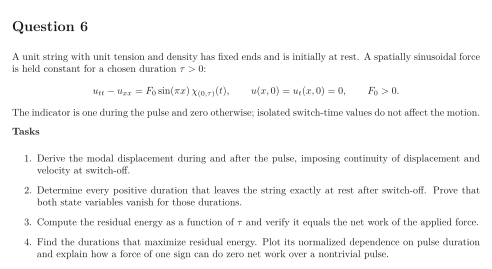
Show solutionHide solution
Question 6 – Solution
Strategy. Switch-off is a delayed negative step in forcing; controlling pulse duration can cancel the entire excited state.
Step 1: Superpose the two forcing steps. Only the first spatial mode is driven. Writing gives with zero initial data. Hence The two expressions and their first derivatives agree at ; only acceleration can jump. They verify the forcing on each open time interval.
Step 2: Find exact cancellation durations. For , the cosine difference becomes Its displacement and velocity vanish identically precisely when , giving . Equivalently, the switch-off state , is zero exactly for those durations.
Step 3: Evaluate residual energy and work. After switch-off, During forcing, the power is . Its integral from zero to is , the same energy.
Step 4: Interpret the pulse-duration curve. The maximum is , attained for , . For an even-integer duration, positive work during motion in the force direction is canceled by negative work while the string moves against the force. A positive force need not supply positive power at every instant.
See the diagram in the original worksheet below.
