Question 7
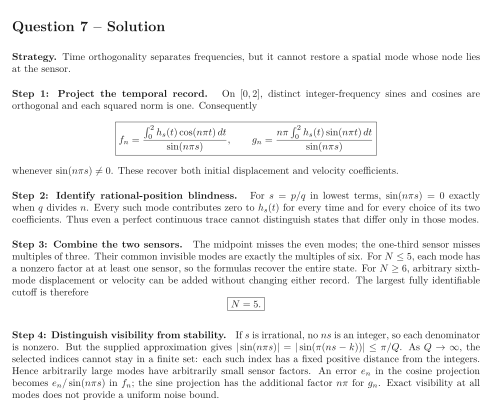
A unit fixed-end string with speed one is known to involve only modes : A displacement sensor at records for .
Tasks
Derive recovery formulas for from the trace whenever the th mode is visible.
For a rational sensor position in lowest terms, identify exactly the invisible modes. Explain why continuous-time sampling cannot recover those modes.
Use sensors at and . Determine their common invisible modes and the largest for which the entire stated finite-mode state is uniquely recoverable.
Prove that an irrational sensor sees every individual mode but can be arbitrarily poorly conditioned as grows. You may use the pigeonhole fact that for every integer there are integers with .
Show solutionHide solution
Question 7 – Solution
Strategy. Time orthogonality separates frequencies, but it cannot restore a spatial mode whose node lies at the sensor.
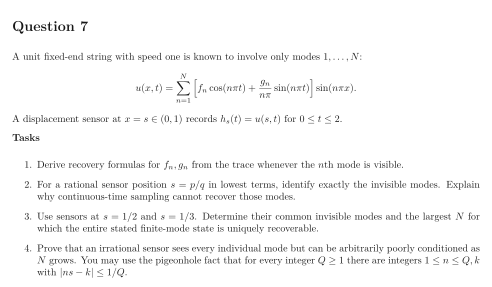
Step 1: Project the temporal record. On , distinct integer-frequency sines and cosines are orthogonal and each squared norm is one. Consequently whenever . These recover both initial displacement and velocity coefficients.
Step 2: Identify rational-position blindness. For in lowest terms, exactly when divides . Every such mode contributes zero to for every time and for every choice of its two coefficients. Thus even a perfect continuous trace cannot distinguish states that differ only in those modes.
Step 3: Combine the two sensors. The midpoint misses the even modes; the one-third sensor misses multiples of three. Their common invisible modes are exactly the multiples of six. For , each mode has a nonzero factor at at least one sensor, so the formulas recover the entire state. For , arbitrary sixth-mode displacement or velocity can be added without changing either record. The largest fully identifiable cutoff is therefore
Step 4: Distinguish visibility from stability. If is irrational, no is an integer, so each denominator is nonzero. But the supplied approximation gives . As , the selected indices cannot stay in a finite set: each such index has a fixed positive distance from the integers. Hence arbitrarily large modes have arbitrarily small sensor factors. An error in the cosine projection becomes in ; the sine projection has the additional factor for . Exact visibility at all modes does not provide a uniform noise bound.