Summary of Separation of Variables — Question 6

PDF ↗

Question 6

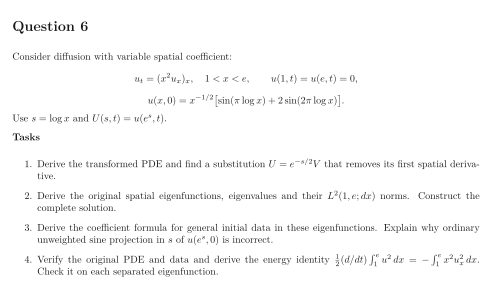
Consider diffusion with variable spatial coefficient: ut=(x2ux)x,1<x<e,u(1,t)=u(e,t)=0,u_t=(x^2u_x)_x,\quad 1<x<e,\qquad u(1,t)=u(e,t)=0, u(x,0)=x−1/2[sin⁡(πlog⁡x)+2sin⁡(2πlog⁡x)].u(x,0)=x^{-1/2}\bigl[\sin(\pi\log x)+2\sin(2\pi\log x)\bigr]. Use s=log⁡xs=\log x and U(s,t)=u(es,t)U(s,t)=u(e^s,t).

Tasks

  1. Derive the transformed PDE and find a substitution U=e−s/2VU=e^{-s/2}V that removes its first spatial derivative.

  2. Derive the original spatial eigenfunctions, eigenvalues and their L2(1,e;dx)L^2(1,e;dx) norms. Construct the complete solution.

  3. Derive the coefficient formula for general initial data in these eigenfunctions. Explain why ordinary unweighted sine projection in ss of u(es,0)u(e^s,0) is incorrect.

  4. Verify the original PDE and data and derive the energy identity 12(d/dt)∫1eu2dx=−∫1ex2ux2dx\tfrac 12(d/dt)\int_1^e u^2\,dx=-\int_1^e x^2u_x^2\,dx. Check it on each separated eigenfunction.
Original worksheet page 1: question and worked solution for 9-9-006
Show solutionHide solution

Question 6 – Solution

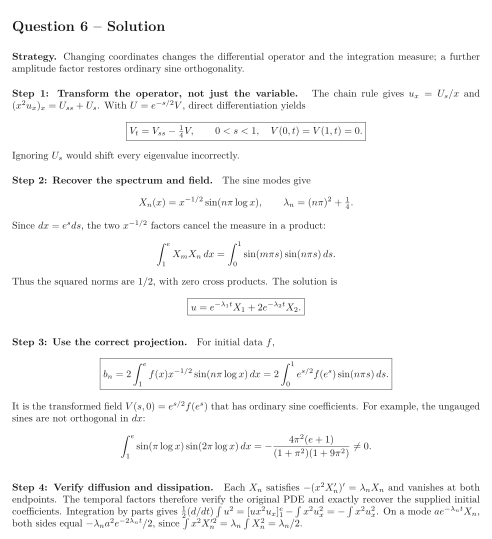
Strategy. Changing coordinates changes the differential operator and the integration measure; a further amplitude factor restores ordinary sine orthogonality.

Step 1: Transform the operator, not just the variable. The chain rule gives ux=Us/xu_x=U_s/x and (x2ux)x=Uss+Us(x^2u_x)_x=U_{ss}+U_s. With U=e−s/2VU=e^{-s/2}V, direct differentiation yields Vt=Vss−14V,0<s<1,V(0,t)=V(1,t)=0.\boxed{V_t=V_{ss}-\tfrac 14V,\qquad 0<s<1,\quad V(0,t)=V(1,t)=0.} Ignoring UsU_s would shift every eigenvalue incorrectly.

Step 2: Recover the spectrum and field. The sine modes give Xn(x)=x−1/2sin⁡(nπlog⁡x),λn=(nπ)2+14.X_n(x)=x^{-1/2}\sin(n\pi\log x),\qquad \lambda_n=(n\pi)^2+\tfrac 14. Since dx=esdsdx=e^sds, the two x−1/2x^{-1/2} factors cancel the measure in a product: ∫1eXmXndx=∫01sin⁡(mπs)sin⁡(nπs)ds.\int_1^eX_mX_n\,dx=\int_0^1\sin(m\pi s)\sin(n\pi s)\,ds. Thus the squared norms are 1/21/2, with zero cross products. The solution is u=e−λ1tX1+2e−λ2tX2.\boxed{u=e^{-\lambda_1t}X_1+2e^{-\lambda_2t}X_2.}

Step 3: Use the correct projection. For initial data ff, bn=2∫1ef(x)x−1/2sin⁡(nπlog⁡x)dx=2∫01es/2f(es)sin⁡(nπs)ds.\boxed{b_n=2\int_1^ef(x)x^{-1/2}\sin(n\pi\log x)\,dx =2\int_0^1e^{s/2}f(e^s)\sin(n\pi s)\,ds.} It is the transformed field V(s,0)=es/2f(es)V(s,0)=e^{s/2}f(e^s) that has ordinary sine coefficients. For example, the ungauged sines are not orthogonal in dxdx: ∫1esin⁡(πlog⁡x)sin⁡(2πlog⁡x)dx=−4π2(e+1)(1+π2)(1+9π2)≠0.\int_1^e\sin(\pi\log x)\sin(2\pi\log x)\,dx =-\frac{4\pi^2(e+1)}{(1+\pi^2)(1+9\pi^2)}\ne 0.

Step 4: Verify diffusion and dissipation. Each XnX_n satisfies −(x2Xn′)′=λnXn-(x^2X_n')'=\lambda_nX_n and vanishes at both endpoints. The temporal factors therefore verify the original PDE and exactly recover the supplied initial coefficients. Integration by parts gives 12(d/dt)∫u2=[ux2ux]1e−∫x2ux2=−∫x2ux2\tfrac 12(d/dt)\int u^2=[ux^2u_x]_1^e-\int x^2u_x^2=-\int x^2u_x^2. On a mode ae−λntXna e^{-\lambda_nt}X_n, both sides equal −λna2e−2λnt/2-\lambda_na^2e^{-2\lambda_nt}/2, since ∫x2Xn′2=λn∫Xn2=λn/2\int x^2X_n'^2=\lambda_n\int X_n^2=\lambda_n/2.

Original worksheet page 2: question and worked solution for 9-9-006

Original worksheet layout. Use Enlarge or open the PDF for a closer view.