Question 6
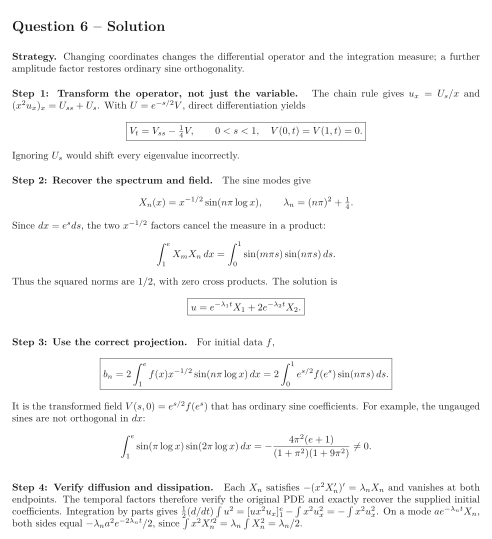
Consider diffusion with variable spatial coefficient: Use and .
Tasks
Derive the transformed PDE and find a substitution that removes its first spatial derivative.
Derive the original spatial eigenfunctions, eigenvalues and their norms. Construct the complete solution.
Derive the coefficient formula for general initial data in these eigenfunctions. Explain why ordinary unweighted sine projection in of is incorrect.
Verify the original PDE and data and derive the energy identity . Check it on each separated eigenfunction.
Show solutionHide solution
Question 6 – Solution
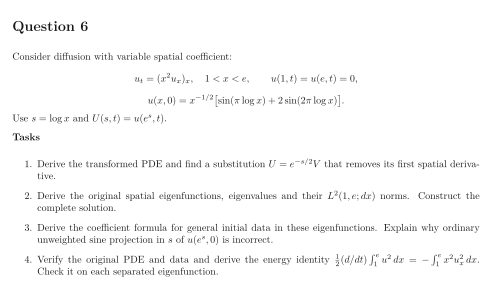
Strategy. Changing coordinates changes the differential operator and the integration measure; a further amplitude factor restores ordinary sine orthogonality.
Step 1: Transform the operator, not just the variable. The chain rule gives and . With , direct differentiation yields Ignoring would shift every eigenvalue incorrectly.
Step 2: Recover the spectrum and field. The sine modes give Since , the two factors cancel the measure in a product: Thus the squared norms are , with zero cross products. The solution is
Step 3: Use the correct projection. For initial data , It is the transformed field that has ordinary sine coefficients. For example, the ungauged sines are not orthogonal in :
Step 4: Verify diffusion and dissipation. Each satisfies and vanishes at both endpoints. The temporal factors therefore verify the original PDE and exactly recover the supplied initial coefficients. Integration by parts gives . On a mode , both sides equal , since .