Trig Functions — Question 8

PDF ↗

Question 8

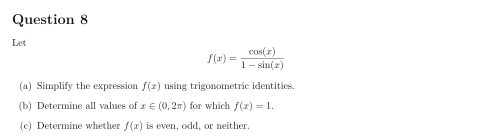
Let f(x)=cos⁡(x)1−sin⁡(x)f(x) = \frac{\cos(x)}{1 - \sin(x)}

  • (a) Simplify the expression f(x)f(x) using trigonometric identities.

  • (b) Determine all values of x∈(0,2π)x \in (0, 2\pi) for which f(x)=1f(x) = 1.

  • (c) Determine whether f(x)f(x) is even, odd, or neither.

Original worksheet page 1: question and worked solution for 1-3-008
Show solutionHide solution

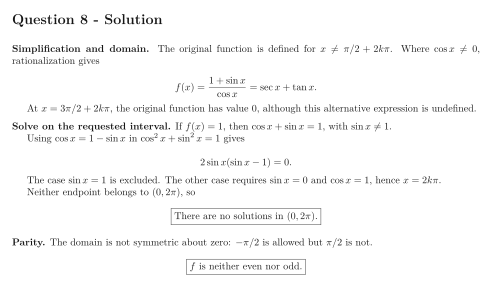
Question 8 - Solution

Simplification and domain. The original function is defined for x≠π/2+2kπx\ne\pi/2+2k\pi. Where cos⁡x≠0\cos x\ne0, rationalization gives

f(x)=1+sin⁡xcos⁡x=sec⁡x+tan⁡x.f(x)=\frac{1+\sin x}{\cos x}=\sec x+\tan x.

At x=3π/2+2kπx=3\pi/2+2k\pi, the original function has value 00, although this alternative expression is undefined.

Solve on the requested interval. If f(x)=1f(x)=1, then cos⁡x+sin⁡x=1\cos x+\sin x=1, with sin⁡x≠1\sin x\ne1.

Using cos⁡x=1−sin⁡x\cos x=1-\sin x in cos⁡2x+sin⁡2x=1\cos^2x+\sin^2x=1 gives

2sin⁡x(sin⁡x−1)=0.2\sin x(\sin x-1)=0.

The case sin⁡x=1\sin x=1 is excluded. The other case requires sin⁡x=0\sin x=0 and cos⁡x=1\cos x=1, hence x=2kπx=2k\pi.

Neither endpoint belongs to (0,2π)(0,2\pi), so

There are no solutions in (0,2π).\boxed{\text{There are no solutions in }(0,2\pi).}

Parity. The domain is not symmetric about zero: −π/2-\pi/2 is allowed but π/2\pi/2 is not.

f is neither even nor odd.\boxed{f\text{ is neither even nor odd}.}

Original worksheet page 2: question and worked solution for 1-3-008

Original worksheet layout. Use Enlarge or open the PDF for a closer view.