Trig Functions — Question 10

PDF ↗

Question 10

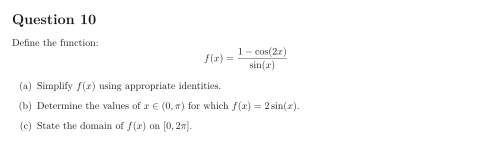
Define the function: f(x)=1−cos⁡(2x)sin⁡(x)f(x) = \frac{1 - \cos(2x)}{\sin(x)}

  • (a) Simplify f(x)f(x) using appropriate identities.

  • (b) Determine the values of x∈(0,π)x \in (0, \pi) for which f(x)=2sin⁡(x)f(x) = 2\sin(x).

  • (c) State the domain of f(x)f(x) on [0,2π][0, 2\pi].

Original worksheet page 1: question and worked solution for 1-3-010
Show solutionHide solution

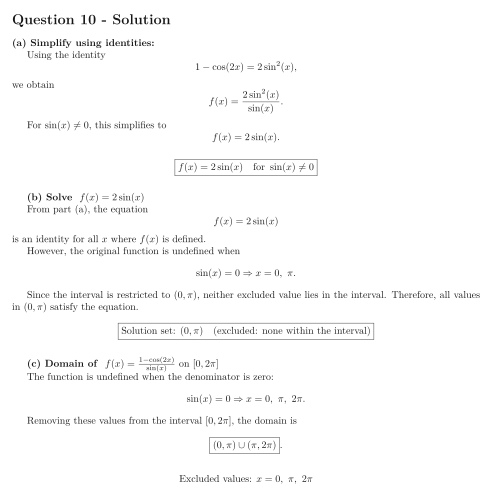
Question 10 - Solution

(a) Simplify using identities:

Using the identity 1−cos⁡(2x)=2sin⁡2(x),1 - \cos(2x) = 2\sin^2(x), we obtain f(x)=2sin⁡2(x)sin⁡(x).f(x) = \frac{2\sin^2(x)}{\sin(x)}.

For sin⁡(x)≠0\sin(x) \neq 0, this simplifies to f(x)=2sin⁡(x).f(x) = 2\sin(x).

f(x)=2sin⁡(x)for sin⁡(x)≠0\boxed{f(x) = 2\sin(x) \quad \text{for } \sin(x) \neq 0}

(b) Solve f(x)=2sin⁡(x)f(x) = 2\sin(x)

From part (a), the equation f(x)=2sin⁡(x)f(x) = 2\sin(x) is an identity for all xx where f(x)f(x) is defined.

However, the original function is undefined when sin⁡(x)=0⇒x=0,π.\sin(x) = 0 \Rightarrow x = 0,\ \pi.

Since the interval is restricted to (0,π)(0, \pi), neither excluded value lies in the interval. Therefore, all values in (0,π)(0, \pi) satisfy the equation.

Solution set: (0,π)(excluded: none within the interval)\boxed{\text{Solution set: } (0, \pi) \quad \text{(excluded: none within the interval)}}

(c) Domain of f(x)=1−cos⁡(2x)sin⁡(x)f(x) = \frac{1 - \cos(2x)}{\sin(x)} on [0,2π][0, 2\pi]

The function is undefined when the denominator is zero: sin⁡(x)=0⇒x=0,π,2π.\sin(x) = 0 \Rightarrow x = 0,\ \pi,\ 2\pi.

Removing these values from the interval [0,2π][0, 2\pi], the domain is (0,π)∪(π,2π).\boxed{(0, \pi) \cup (\pi, 2\pi)}.

Excluded values: x=0,π,2π\text{Excluded values: } x = 0,\ \pi,\ 2\pi

Original worksheet page 2: question and worked solution for 1-3-010

Original worksheet layout. Use Enlarge or open the PDF for a closer view.