Higher Order Derivatives — Question 2

PDF ↗

Question 2

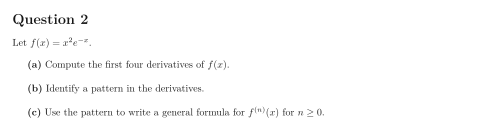
Let f(x)=x2e−xf(x) = x^2 e^{-x}.

(a) Compute the first four derivatives of f(x)f(x).
(b) Identify a pattern in the derivatives.
(c) Use the pattern to write a general formula for f(n)(x)f^{(n)}(x) for n≥0n \geq 0.

Original worksheet page 1: question and worked solution for 3-12-002
Show solutionHide solution

Question 2 - Solution

We are given f(x)=x2e−xf(x) = x^2 e^{-x}. Let’s compute derivatives step-by-step.

(a) First, compute the derivatives:

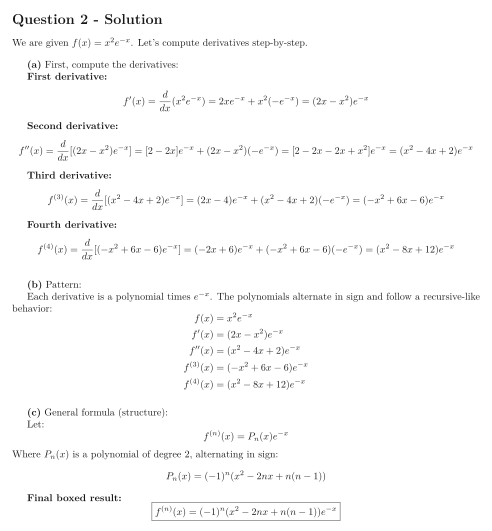
First derivative: f′(x)=ddx(x2e−x)=2xe−x+x2(−e−x)=(2x−x2)e−xf'(x) = \frac{d}{dx}(x^2 e^{-x}) = 2x e^{-x} + x^2 (-e^{-x}) = (2x - x^2) e^{-x}

Second derivative: f″(x)=ddx[(2x−x2)e−x]=[2−2x]e−x+(2x−x2)(−e−x)=[2−2x−2x+x2]e−x=(x2−4x+2)e−x\begin{gathered} f''(x) = \frac{d}{dx}[(2x - x^2)e^{-x}] = [2 - 2x] e^{-x} + (2x - x^2)(-e^{-x}) \\ = [2 - 2x - 2x + x^2] e^{-x} = (x^2 - 4x + 2) e^{-x} \end{gathered}

Third derivative: f(3)(x)=ddx[(x2−4x+2)e−x]=(2x−4)e−x+(x2−4x+2)(−e−x)=(−x2+6x−6)e−x\begin{gathered} f^{(3)}(x) = \frac{d}{dx}[(x^2 - 4x + 2)e^{-x}] \\ = (2x - 4)e^{-x} + (x^2 - 4x + 2)(-e^{-x}) \\ = (-x^2 + 6x - 6)e^{-x} \end{gathered}

Fourth derivative: f(4)(x)=ddx[(−x2+6x−6)e−x]=(−2x+6)e−x+(−x2+6x−6)(−e−x)=(x2−8x+12)e−x\begin{gathered} f^{(4)}(x) = \frac{d}{dx}[(-x^2 + 6x - 6)e^{-x}] \\ = (-2x + 6)e^{-x} + (-x^2 + 6x - 6)(-e^{-x}) \\ = (x^2 - 8x + 12)e^{-x} \end{gathered}

(b) Pattern:

Each derivative is a polynomial times e−xe^{-x}. The polynomials alternate in sign and follow a recursive-like behavior: f(x)=x2e−xf′(x)=(2x−x2)e−xf″(x)=(x2−4x+2)e−xf(3)(x)=(−x2+6x−6)e−xf(4)(x)=(x2−8x+12)e−x\begin{aligned} f(x) &= x^2 e^{-x} \\ f'(x) &= (2x - x^2)e^{-x} \\ f''(x) &= (x^2 - 4x + 2)e^{-x} \\ f^{(3)}(x) &= (-x^2 + 6x - 6)e^{-x} \\ f^{(4)}(x) &= (x^2 - 8x + 12)e^{-x} \end{aligned}

(c) General formula (structure):

Let: f(n)(x)=Pn(x)e−xf^{(n)}(x) = P_n(x) e^{-x} Where Pn(x)P_n(x) is a polynomial of degree 2, alternating in sign: Pn(x)=(−1)n(x2−2nx+n(n−1))P_n(x) = (-1)^n(x^2 - 2nx + n(n-1))

Final boxed result: f(n)(x)=(−1)n(x2−2nx+n(n−1))e−x\boxed{f^{(n)}(x) = (-1)^n (x^2 - 2nx + n(n-1)) e^{-x}}

Original worksheet page 2: question and worked solution for 3-12-002

Original worksheet layout. Use Enlarge or open the PDF for a closer view.