Higher Order Derivatives — Question 3

PDF ↗

Question 3

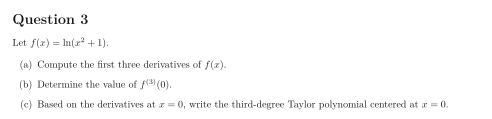
Let f(x)=ln⁡(x2+1)f(x) = \ln(x^2 + 1).

  • (a) Compute the first three derivatives of f(x)f(x).

  • (b) Determine the value of f(3)(0)f^{(3)}(0).

  • (c) Based on the derivatives at x=0x = 0, write the third-degree Taylor polynomial centered at x=0x = 0.

Original worksheet page 1: question and worked solution for 3-12-003
Show solutionHide solution

Question 3 - Solution

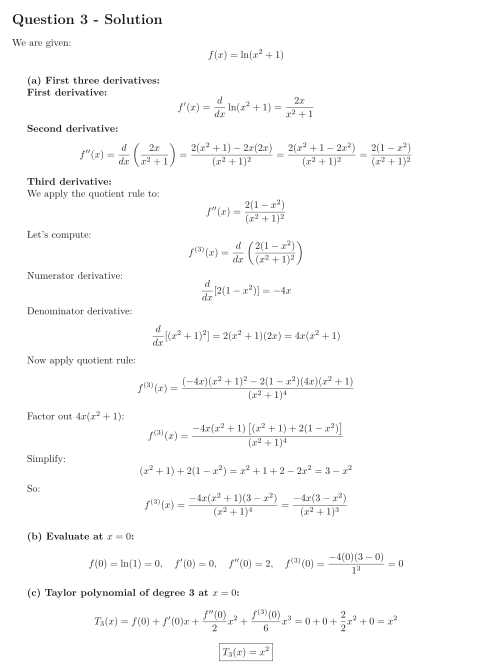
We are given: f(x)=ln⁡(x2+1)f(x) = \ln(x^2 + 1)

(a) First three derivatives:

First derivative: f′(x)=ddxln⁡(x2+1)=2xx2+1f'(x) = \frac{d}{dx} \ln(x^2 + 1) = \frac{2x}{x^2 + 1}

Second derivative: f″(x)=ddx(2xx2+1)=2(x2+1)−2x(2x)(x2+1)2=2(x2+1−2x2)(x2+1)2=2(1−x2)(x2+1)2f''(x) = \frac{d}{dx} \left( \frac{2x}{x^2 + 1} \right) = \frac{2(x^2 + 1) - 2x(2x)}{(x^2 + 1)^2} = \frac{2(x^2 + 1 - 2x^2)}{(x^2 + 1)^2} = \frac{2(1 - x^2)}{(x^2 + 1)^2}

Third derivative:

We apply the quotient rule to: f″(x)=2(1−x2)(x2+1)2f''(x) = \frac{2(1 - x^2)}{(x^2 + 1)^2}

Let’s compute: f(3)(x)=ddx(2(1−x2)(x2+1)2)f^{(3)}(x) = \frac{d}{dx} \left( \frac{2(1 - x^2)}{(x^2 + 1)^2} \right)

Numerator derivative: ddx[2(1−x2)]=−4x\frac{d}{dx}[2(1 - x^2)] = -4x

Denominator derivative: ddx[(x2+1)2]=2(x2+1)(2x)=4x(x2+1)\frac{d}{dx}[(x^2 + 1)^2] = 2(x^2 + 1)(2x) = 4x(x^2 + 1)

Now apply quotient rule: f(3)(x)=(−4x)(x2+1)2−2(1−x2)(4x)(x2+1)(x2+1)4f^{(3)}(x) = \frac{(-4x)(x^2 + 1)^2 - 2(1 - x^2)(4x)(x^2 + 1)}{(x^2 + 1)^4}

Factor out 4x(x2+1)4x(x^2 + 1): f(3)(x)=−4x(x2+1)[(x2+1)+2(1−x2)](x2+1)4f^{(3)}(x) = \frac{-4x(x^2 + 1)\left[(x^2 + 1) + 2(1 - x^2)\right]}{(x^2 + 1)^4}

Simplify: (x2+1)+2(1−x2)=x2+1+2−2x2=3−x2(x^2 + 1) + 2(1 - x^2) = x^2 + 1 + 2 - 2x^2 = 3 - x^2

So: f(3)(x)=−4x(x2+1)(3−x2)(x2+1)4=−4x(3−x2)(x2+1)3f^{(3)}(x) = \frac{-4x(x^2 + 1)(3 - x^2)}{(x^2 + 1)^4} = \frac{-4x(3 - x^2)}{(x^2 + 1)^3}

(b) Evaluate at x=0x = 0:

f(0)=ln⁡(1)=0,f′(0)=0,f″(0)=2,f(3)(0)=−4(0)(3−0)13=0f(0) = \ln(1) = 0, \quad f'(0) = 0, \quad f''(0) = 2, \quad f^{(3)}(0) = \frac{-4(0)(3 - 0)}{1^3} = 0

(c) Taylor polynomial of degree 3 at x=0x = 0:

T3(x)=f(0)+f′(0)x+f″(0)2x2+f(3)(0)6x3=0+0+22x2+0=x2T_3(x) = f(0) + f'(0)x + \frac{f''(0)}{2}x^2 + \frac{f^{(3)}(0)}{6}x^3 = 0 + 0 + \frac{2}{2}x^2 + 0 = x^2

T3(x)=x2\boxed{T_3(x) = x^2}

Original worksheet page 2: question and worked solution for 3-12-003

Original worksheet layout. Use Enlarge or open the PDF for a closer view.