Differentiation Formulas — Question 3

PDF ↗

Question 3

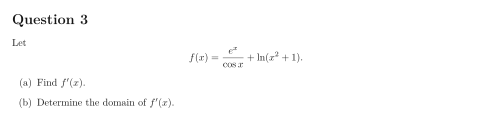
Let f(x)=excos⁡x+ln⁡(x2+1).f(x) = \frac{e^x}{\cos x} + \ln(x^2 + 1).

  • (a) Find f′(x)f'(x).

  • (b) Determine the domain of f′(x)f'(x).

Original worksheet page 1: question and worked solution for 3-3-003
Show solutionHide solution

Question 3 - Solution

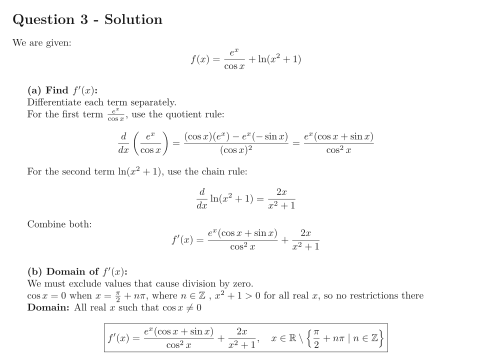
We are given: f(x)=excos⁡x+ln⁡(x2+1)f(x) = \frac{e^x}{\cos x} + \ln(x^2 + 1)

(a) Find f′(x)f'(x):

Differentiate each term separately.

For the first term excos⁡x\frac{e^x}{\cos x}, use the quotient rule: ddx(excos⁡x)=(cos⁡x)(ex)−ex(−sin⁡x)(cos⁡x)2=ex(cos⁡x+sin⁡x)cos⁡2x\frac{d}{dx} \left( \frac{e^x}{\cos x} \right) = \frac{(\cos x)(e^x) - e^x(-\sin x)}{(\cos x)^2} = \frac{e^x(\cos x + \sin x)}{\cos^2 x}

For the second term ln⁡(x2+1)\ln(x^2 + 1), use the chain rule: ddxln⁡(x2+1)=2xx2+1\frac{d}{dx} \ln(x^2 + 1) = \frac{2x}{x^2 + 1}

Combine both: f′(x)=ex(cos⁡x+sin⁡x)cos⁡2x+2xx2+1f'(x) = \frac{e^x(\cos x + \sin x)}{\cos^2 x} + \frac{2x}{x^2 + 1}

(b) Domain of f′(x)f'(x):

We must exclude values that cause division by zero.

cos⁡x=0\cos x = 0 when x=π2+nπx = \frac{\pi}{2} + n\pi, where n∈ℤn \in \mathbb{Z} , x2+1>0x^2 + 1 > 0 for all real xx, so no restrictions there

Domain: All real xx such that cos⁡x≠0\cos x \neq 0

f′(x)=ex(cos⁡x+sin⁡x)cos⁡2x+2xx2+1,x∈ℝ\{π2+nπ∣n∈ℤ}\boxed{f'(x) = \frac{e^x(\cos x + \sin x)}{\cos^2 x} + \frac{2x}{x^2 + 1}, \quad x \in \mathbb{R} \setminus \left\{ \frac{\pi}{2} + n\pi \mid n \in \mathbb{Z} \right\}}

Original worksheet page 2: question and worked solution for 3-3-003

Original worksheet layout. Use Enlarge or open the PDF for a closer view.