Differentiation Formulas — Question 5

PDF ↗

Question 5

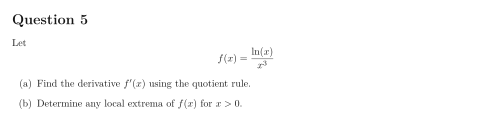
Let f(x)=ln⁡(x)x3f(x) = \frac{\ln(x)}{x^3}

  • (a) Find the derivative f′(x)f'(x) using the quotient rule.

  • (b) Determine any local extrema of f(x)f(x) for x>0x > 0.

Original worksheet page 1: question and worked solution for 3-3-005
Show solutionHide solution

Question 5 - Solution

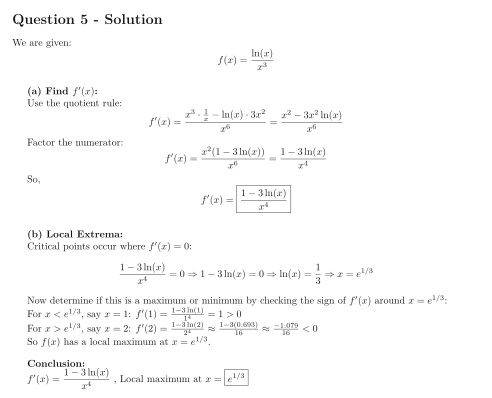
We are given: f(x)=ln⁡(x)x3f(x) = \frac{\ln(x)}{x^3}

(a) Find f′(x)f'(x):

Use the quotient rule: f′(x)=x3⋅1x−ln⁡(x)⋅3x2x6=x2−3x2ln⁡(x)x6f'(x) = \frac{x^3 \cdot \frac{1}{x} - \ln(x) \cdot 3x^2}{x^6} = \frac{x^2 - 3x^2 \ln(x)}{x^6}

Factor the numerator: f′(x)=x2(1−3ln⁡(x))x6=1−3ln⁡(x)x4f'(x) = \frac{x^2(1 - 3\ln(x))}{x^6} = \frac{1 - 3\ln(x)}{x^4}

So, f′(x)=1−3ln⁡(x)x4f'(x) = \boxed{\frac{1 - 3\ln(x)}{x^4}}

(b) Local Extrema:

Critical points occur where f′(x)=0f'(x) = 0: 1−3ln⁡(x)x4=0⇒1−3ln⁡(x)=0⇒ln⁡(x)=13⇒x=e1/3\frac{1 - 3\ln(x)}{x^4} = 0 \Rightarrow 1 - 3\ln(x) = 0 \Rightarrow \ln(x) = \frac{1}{3} \Rightarrow x = e^{1/3}

Now determine if this is a maximum or minimum by checking the sign of f′(x)f'(x) around x=e1/3x = e^{1/3}:

For x<e1/3x < e^{1/3}, say x=1x = 1: f′(1)=1−3ln⁡(1)14=1>0f'(1) = \frac{1 - 3\ln(1)}{1^4} = 1 > 0

For x>e1/3x > e^{1/3}, say x=2x = 2: f′(2)=1−3ln⁡(2)24≈1−3(0.693)16≈−1.07916<0f'(2) = \frac{1 - 3\ln(2)}{2^4} \approx \frac{1 - 3(0.693)}{16} \approx \frac{-1.079}{16} < 0

So f(x)f(x) has a local maximum at x=e1/3x = e^{1/3}.

Conclusion:

f′(x)=1−3ln⁡(x)x4f'(x) = \dfrac{1 - 3\ln(x)}{x^4} , Local maximum at x=e1/3x = \boxed{e^{1/3}}

Original worksheet page 2: question and worked solution for 3-3-005

Original worksheet layout. Use Enlarge or open the PDF for a closer view.