Derivatives of Exponential and Logarithm Functions — Question 9

PDF ↗

Question 9

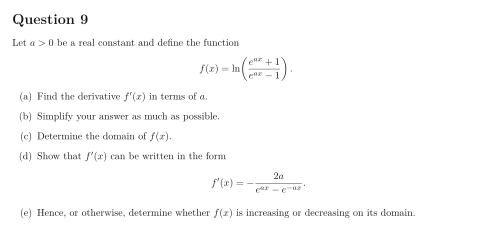
Let a>0a > 0 be a real constant and define the function f(x)=ln⁡(eax+1eax−1).f(x) = \ln\!\left(\frac{e^{ax} + 1}{e^{ax} - 1}\right).

  • (a) Find the derivative f′(x)f'(x) in terms of aa.

  • (b) Simplify your answer as much as possible.

  • (c) Determine the domain of f(x)f(x).

  • (d) Show that f′(x)f'(x) can be written in the form f′(x)=−2aeax−e−ax.f'(x) = -\frac{2a}{e^{ax} - e^{-ax}}.

  • (e) Hence, or otherwise, determine whether f(x)f(x) is increasing or decreasing on its domain.

Original worksheet page 1: question and worked solution for 3-6-009
Show solutionHide solution

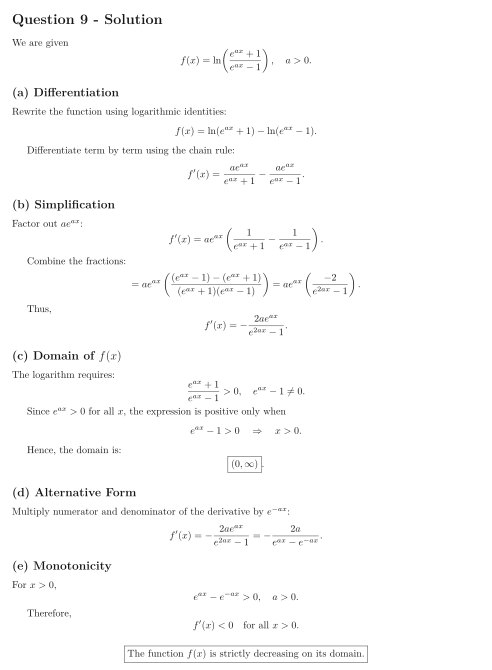
Question 9 - Solution

We are given f(x)=ln⁡(eax+1eax−1),a>0.f(x) = \ln\!\left(\frac{e^{ax} + 1}{e^{ax} - 1}\right), \quad a > 0.

(a) Differentiation

Rewrite the function using logarithmic identities: f(x)=ln⁡(eax+1)−ln⁡(eax−1).f(x) = \ln(e^{ax} + 1) - \ln(e^{ax} - 1).

Differentiate term by term using the chain rule: f′(x)=aeaxeax+1−aeaxeax−1.f'(x) = \frac{a e^{ax}}{e^{ax} + 1} - \frac{a e^{ax}}{e^{ax} - 1}.

(b) Simplification

Factor out aeaxa e^{ax}: f′(x)=aeax(1eax+1−1eax−1).f'(x) = a e^{ax}\left(\frac{1}{e^{ax} + 1} - \frac{1}{e^{ax} - 1}\right).

Combine the fractions: =aeax((eax−1)−(eax+1)(eax+1)(eax−1))=aeax(−2e2ax−1).= a e^{ax} \left( \frac{(e^{ax} - 1) - (e^{ax} + 1)}{(e^{ax} + 1)(e^{ax} - 1)} \right) = a e^{ax} \left( \frac{-2}{e^{2ax} - 1} \right).

Thus, f′(x)=−2aeaxe2ax−1.f'(x) = -\frac{2a e^{ax}}{e^{2ax} - 1}.

(c) Domain of f(x)f(x)

The logarithm requires: eax+1eax−1>0,eax−1≠0.\frac{e^{ax} + 1}{e^{ax} - 1} > 0, \quad e^{ax} - 1 \neq 0.

Since eax>0e^{ax} > 0 for all xx, the expression is positive only when eax−1>0⇒x>0.e^{ax} - 1 > 0 \quad \Rightarrow \quad x > 0.

Hence, the domain is: (0,∞).\boxed{(0, \infty)}.

(d) Alternative Form

Multiply numerator and denominator of the derivative by e−axe^{-ax}: f′(x)=−2aeaxe2ax−1=−2aeax−e−ax.f'(x) = -\frac{2a e^{ax}}{e^{2ax} - 1} = -\frac{2a}{e^{ax} - e^{-ax}}.

(e) Monotonicity

For x>0x > 0, eax−e−ax>0,a>0.e^{ax} - e^{-ax} > 0, \quad a > 0.

Therefore, f′(x)<0for all x>0.f'(x) < 0 \quad \text{for all } x > 0.

The function f(x) is strictly decreasing on its domain.\boxed{\text{The function } f(x) \text{ is strictly decreasing on its domain.}}

Original worksheet page 2: question and worked solution for 3-6-009

Original worksheet layout. Use Enlarge or open the PDF for a closer view.