Derivatives of Exponential and Logarithm Functions — Question 10

PDF ↗

Question 10

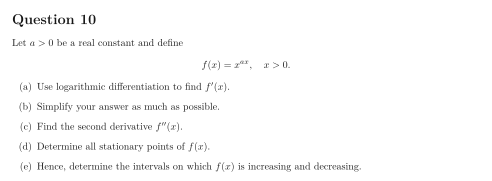
Let a>0a > 0 be a real constant and define f(x)=xax,x>0.f(x) = x^{ax}, \quad x > 0.

  • (a) Use logarithmic differentiation to find f′(x)f'(x).

  • (b) Simplify your answer as much as possible.

  • (c) Find the second derivative f″(x)f''(x).

  • (d) Determine all stationary points of f(x)f(x).

  • (e) Hence, determine the intervals on which f(x)f(x) is increasing and decreasing.

Original worksheet page 1: question and worked solution for 3-6-010
Show solutionHide solution

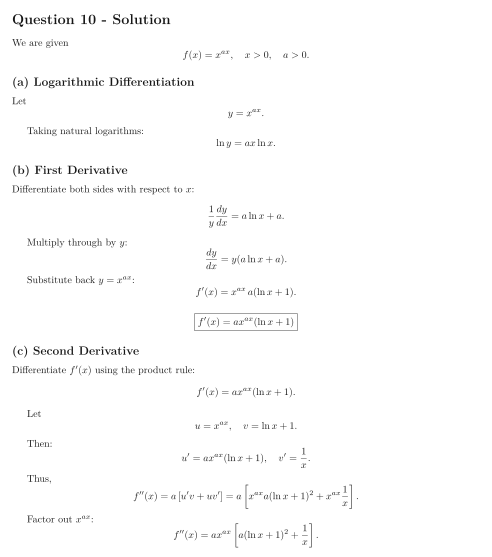
Question 10 - Solution

We are given f(x)=xax,x>0,a>0.f(x) = x^{ax}, \quad x > 0, \quad a > 0.

(a) Logarithmic Differentiation

Let y=xax.y = x^{ax}.

Taking natural logarithms: ln⁡y=axln⁡x.\ln y = ax \ln x.

(b) First Derivative

Differentiate both sides with respect to xx: 1ydydx=aln⁡x+a.\frac{1}{y} \frac{dy}{dx} = a \ln x + a.

Multiply through by yy: dydx=y(aln⁡x+a).\frac{dy}{dx} = y(a \ln x + a).

Substitute back y=xaxy = x^{ax}: f′(x)=xaxa(ln⁡x+1).f'(x) = x^{ax} \, a(\ln x + 1).

f′(x)=axax(ln⁡x+1)\boxed{f'(x) = a x^{ax}(\ln x + 1)}

(c) Second Derivative

Differentiate f′(x)f'(x) using the product rule: f′(x)=axax(ln⁡x+1).f'(x) = a x^{ax}(\ln x + 1).

Let u=xax,v=ln⁡x+1.u = x^{ax}, \quad v = \ln x + 1.

Then: u′=axax(ln⁡x+1),v′=1x.u' = a x^{ax}(\ln x + 1), \quad v' = \frac{1}{x}.

Thus, f″(x)=a[u′v+uv′]=a[xaxa(lnx+1)2+xax1x].f''(x) = a\left[u'v + uv'\right] = a\left[x^{ax} a(\ln x + 1)^2 + x^{ax} \frac{1}{x}\right].

Factor out xaxx^{ax}: f″(x)=axax[a(lnx+1)2+1x].f''(x) = a x^{ax} \left[a(\ln x + 1)^2 + \frac{1}{x}\right].

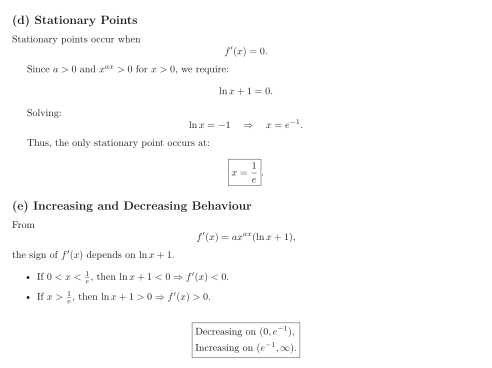
(d) Stationary Points

Stationary points occur when f′(x)=0.f'(x) = 0.

Since a>0a > 0 and xax>0x^{ax} > 0 for x>0x > 0, we require: ln⁡x+1=0.\ln x + 1 = 0.

Solving: ln⁡x=−1⇒x=e−1.\ln x = -1 \quad \Rightarrow \quad x = e^{-1}.

Thus, the only stationary point occurs at: x=1e.\boxed{x = \frac{1}{e}}.

(e) Increasing and Decreasing Behaviour

From f′(x)=axax(ln⁡x+1),f'(x) = a x^{ax}(\ln x + 1), the sign of f′(x)f'(x) depends on ln⁡x+1\ln x + 1.

  • If 0<x<1e0 < x < \frac{1}{e}, then ln⁡x+1<0⇒f′(x)<0\ln x + 1 < 0 \Rightarrow f'(x) < 0.

  • If x>1ex > \frac{1}{e}, then ln⁡x+1>0⇒f′(x)>0\ln x + 1 > 0 \Rightarrow f'(x) > 0.

Decreasing on (0,e−1),Increasing on (e−1,∞).\boxed{ \begin{aligned} &\text{Decreasing on } (0, e^{-1}), \\ &\text{Increasing on } (e^{-1}, \infty). \end{aligned} }

Original worksheet page 2: question and worked solution for 3-6-010
Original worksheet page 3: question and worked solution for 3-6-010

Original worksheet layout. Use Enlarge or open the PDF for a closer view.