Rates of Change — Question 8

PDF ↗

Question 8

Problem:

A 10-foot ladder is leaning against a vertical wall. The bottom of the ladder is sliding away from the wall at a rate of 2 ft/s. How fast is the top of the ladder sliding down the wall when the bottom of the ladder is 6 feet from the wall?

See the diagram in the original worksheet below.
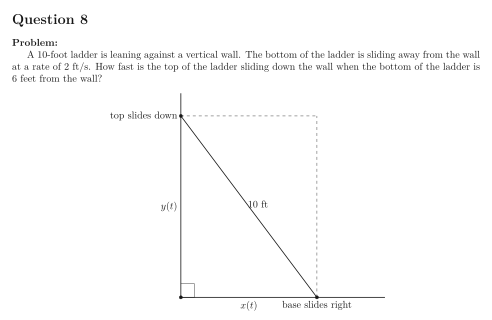
Original worksheet page 1: question and worked solution for 4-1-008
Show solutionHide solution

Question 8 - Solution

Let:

  • x(t)x(t): distance from the wall to the base of the ladder

  • y(t)y(t): height of the top of the ladder on the wall

  • Given: dxdt=2ft/s,x=6\frac{dx}{dt} = 2 \, \text{ft/s}, \quad x = 6

Using the Pythagorean theorem:

x2+y2=102=100x^2 + y^2 = 10^2 = 100

Differentiate both sides with respect to time tt:

2xdxdt+2ydydt=0⇒xdxdt+ydydt=02x \frac{dx}{dt} + 2y \frac{dy}{dt} = 0 \Rightarrow x \frac{dx}{dt} + y \frac{dy}{dt} = 0

We know: x=6,dxdt=2x = 6, \quad \frac{dx}{dt} = 2

Solve for yy:

36+y2=100⇒y2=64⇒y=836 + y^2 = 100 \Rightarrow y^2 = 64 \Rightarrow y = 8

Substitute into the differentiated equation:

6(2)+8dydt=0⇒12+8dydt=0⇒dydt=−128=−326(2) + 8 \frac{dy}{dt} = 0 \Rightarrow 12 + 8 \frac{dy}{dt} = 0 \Rightarrow \frac{dy}{dt} = -\frac{12}{8} = -\frac{3}{2}

Answer: dydt=−32 ft/s\boxed{\frac{dy}{dt} = -\frac{3}{2} \text{ ft/s}}

The negative sign indicates that the top of the ladder is sliding downward.
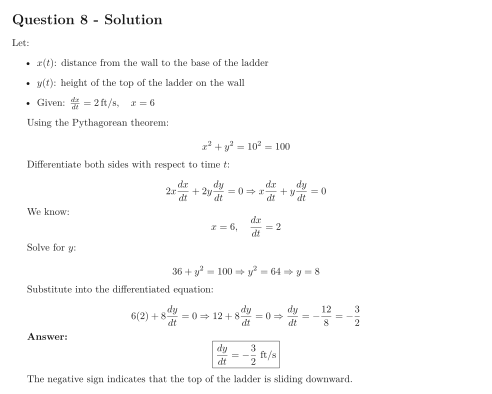
Original worksheet page 2: question and worked solution for 4-1-008

Original worksheet layout. Use Enlarge or open the PDF for a closer view.