Rates of Change — Question 9

PDF ↗

Question 9

Problem:

A balloon is rising vertically at a constant rate of 5ft/s5 \, \text{ft/s}, and at the same time, a car drives directly away from the point on the ground beneath the balloon at 60ft/s60 \, \text{ft/s}. How fast is the distance between the car and the balloon increasing when the car is 80 feet from the balloon’s launch point and the balloon is 150 feet high?

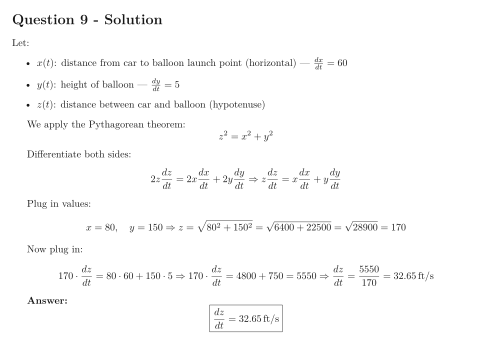
See the diagram in the original worksheet below.

Original worksheet page 1: question and worked solution for 4-1-009
Show solutionHide solution

Question 9 - Solution

Let:

  • x(t)x(t): distance from car to balloon launch point (horizontal) — dxdt=60\frac{dx}{dt} = 60

  • y(t)y(t): height of balloon — dydt=5\frac{dy}{dt} = 5

  • z(t)z(t): distance between car and balloon (hypotenuse)

We apply the Pythagorean theorem: z2=x2+y2z^2 = x^2 + y^2

Differentiate both sides: 2zdzdt=2xdxdt+2ydydt⇒zdzdt=xdxdt+ydydt2z \frac{dz}{dt} = 2x \frac{dx}{dt} + 2y \frac{dy}{dt} \Rightarrow z \frac{dz}{dt} = x \frac{dx}{dt} + y \frac{dy}{dt}

Plug in values: x=80,y=150⇒z=802+1502=6400+22500=28900=170x = 80, \quad y = 150 \Rightarrow z = \sqrt{80^2 + 150^2} = \sqrt{6400 + 22500} = \sqrt{28900} = 170

Now plug in: 170⋅dzdt=80⋅60+150⋅5⇒170⋅dzdt=4800+750=5550⇒dzdt=5550170=32.65ft/s170 \cdot \frac{dz}{dt} = 80 \cdot 60 + 150 \cdot 5 \Rightarrow 170 \cdot \frac{dz}{dt} = 4800 + 750 = 5550 \Rightarrow \frac{dz}{dt} = \frac{5550}{170} = 32.65 \, \text{ft/s}

Answer: dzdt=32.65ft/s\boxed{\frac{dz}{dt} = 32.65 \, \text{ft/s}}

Original worksheet page 2: question and worked solution for 4-1-009

Original worksheet layout. Use Enlarge or open the PDF for a closer view.