Rates of Change — Question 10

PDF ↗

Question 10

Problem:

A hot air balloon is descending vertically at a rate of 2ft/s2 \, \text{ft/s}, while a bicyclist passes directly beneath it, traveling in a straight line at a speed of 15ft/s15 \, \text{ft/s}. How fast is the distance between the bicyclist and the balloon changing when the bicyclist is 60 feet from the point directly below the balloon and the balloon is 100 feet above the ground?

See the diagram in the original worksheet below.

Original worksheet page 1: question and worked solution for 4-1-010
Show solutionHide solution

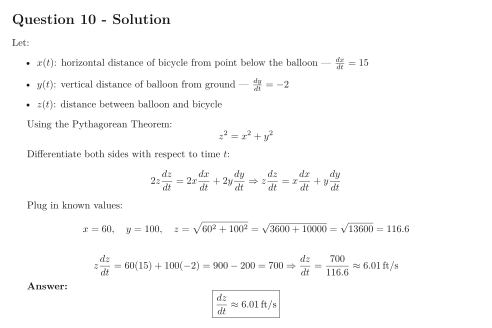
Question 10 - Solution

Let:

  • x(t)x(t): horizontal distance of bicycle from point below the balloon — dxdt=15\frac{dx}{dt} = 15

  • y(t)y(t): vertical distance of balloon from ground — dydt=−2\frac{dy}{dt} = -2

  • z(t)z(t): distance between balloon and bicycle

Using the Pythagorean Theorem: z2=x2+y2z^2 = x^2 + y^2

Differentiate both sides with respect to time tt: 2zdzdt=2xdxdt+2ydydt⇒zdzdt=xdxdt+ydydt2z \frac{dz}{dt} = 2x \frac{dx}{dt} + 2y \frac{dy}{dt} \Rightarrow z \frac{dz}{dt} = x \frac{dx}{dt} + y \frac{dy}{dt}

Plug in known values: x=60,y=100,z=602+1002=3600+10000=13600=116.6x = 60, \quad y = 100, \quad z = \sqrt{60^2 + 100^2} = \sqrt{3600 + 10000} = \sqrt{13600} = 116.6

zdzdt=60(15)+100(−2)=900−200=700⇒dzdt=700116.6≈6.01ft/sz \frac{dz}{dt} = 60(15) + 100(-2) = 900 - 200 = 700 \Rightarrow \frac{dz}{dt} = \frac{700}{116.6} \approx 6.01 \, \text{ft/s}

Answer: dzdt≈6.01ft/s\boxed{\frac{dz}{dt} \approx 6.01 \, \text{ft/s}}

Original worksheet page 2: question and worked solution for 4-1-010

Original worksheet layout. Use Enlarge or open the PDF for a closer view.