The Shape of a Graph, Part I — Question 3

PDF ↗

Question 3

Problem

Consider the function f(x)=x2−4xx+1f(x) = \frac{x^2 - 4x}{x + 1}

(a) Find the intervals where f(x)f(x) is increasing or decreasing.

(b) Identify any local maximum or minimum points.
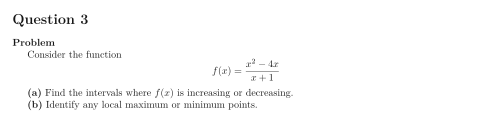
Original worksheet page 1: question and worked solution for 4-5-003
Show solutionHide solution

Question 3 - Solution

We are given f(x)=x2−4xx+1=x(x−4)x+1,x≠−1f(x) = \frac{x^2 - 4x}{x + 1} = \frac{x(x-4)}{x+1}, \qquad x \neq -1

(a) First derivative

Using the quotient rule, f′(x)=(x+1)(2x−4)−(x2−4x)(x+1)2=x2+2x−4(x+1)2.f'(x) = \frac{(x+1)(2x-4)-(x^2-4x)}{(x+1)^2} = \frac{x^2+2x-4}{(x+1)^2}.

Setting the numerator equal to zero gives x2+2x−4=0⇒x=−1±5.x^2+2x-4=0 \Rightarrow x=-1\pm\sqrt{5}.

Since (x+1)2>0(x+1)^2>0 for x≠−1x\neq -1, the sign of f′(x)f'(x) is determined by the numerator.

Answer

The function is increasing on (−∞,−1−5)∪(−1+5,∞).\boxed{(-\infty,-1-\sqrt{5}) \cup (-1+\sqrt{5},\infty)}.

The function is decreasing on (−1−5,−1)∪(−1,−1+5).\boxed{(-1-\sqrt{5},-1) \cup (-1,-1+\sqrt{5})}.

(b) Local extrema

At x=−1−5x=-1-\sqrt{5}, the derivative changes from positive to negative, so there is a local maximum.

At x=−1+5x=-1+\sqrt{5}, the derivative changes from negative to positive, so there is a local minimum.

f(−1−5)=−6−25,f(−1+5)=−6+25.f(-1-\sqrt{5})=-6-2\sqrt{5}, \qquad f(-1+\sqrt{5})=-6+2\sqrt{5}.

Answer

Local maximum at (−1−5,−6−25)\boxed{\left(-1-\sqrt{5},-6-2\sqrt{5}\right)}

Local minimum at (−1+5,−6+25)\boxed{\left(-1+\sqrt{5},-6+2\sqrt{5}\right)}

Graph of f(x)f(x)

See the diagram in the original worksheet below.

Original worksheet page 2: question and worked solution for 4-5-003

Original worksheet layout. Use Enlarge or open the PDF for a closer view.