The Mean Value Theorem — Question 2

PDF ↗

Question 2

Problem:

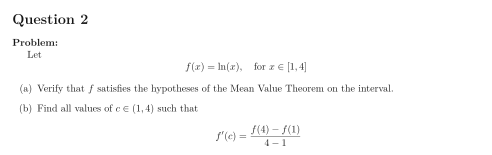
Let f(x)=ln⁡(x),for x∈[1,4]f(x) = \ln(x), \quad \text{for } x \in [1, 4]

  • (a) Verify that ff satisfies the hypotheses of the Mean Value Theorem on the interval.

  • (b) Find all values of c∈(1,4)c \in (1, 4) such that f′(c)=f(4)−f(1)4−1f'(c) = \frac{f(4) - f(1)}{4 - 1}

Original worksheet page 1: question and worked solution for 4-7-002
Show solutionHide solution

Question 2 - Solution

We are given: f(x)=ln⁡(x)f(x) = \ln(x)

(a) Check MVT hypotheses:

1. f(x)f(x) is continuous on [1,4][1, 4]: Yes, ln⁡(x)\ln(x) is continuous for x>0x > 0, so continuous on [1,4][1, 4]

2. f(x)f(x) is differentiable on (1,4)(1, 4): Yes, ln⁡(x)\ln(x) is differentiable for x>0x > 0, so differentiable on (1,4)(1, 4)

✅ The Mean Value Theorem applies.

(b) Find the value(s) of cc:

Compute average rate of change: f(4)−f(1)4−1=ln⁡(4)−ln⁡(1)3=ln⁡(4)3=2ln⁡(2)3\frac{f(4) - f(1)}{4 - 1} = \frac{\ln(4) - \ln(1)}{3} = \frac{\ln(4)}{3} = \frac{2\ln(2)}{3}

Now compute f′(x)f'(x): f′(x)=1xf'(x) = \frac{1}{x}

Set: f′(c)=1c=2ln⁡(2)3⇒c=32ln⁡(2)f'(c) = \frac{1}{c} = \frac{2\ln(2)}{3} \quad \Rightarrow \quad c = \frac{3}{2\ln(2)}

Answer: c=32ln⁡(2)≈2.164\boxed{c = \frac{3}{2\ln(2)} \approx 2.164}

Graph of f(x)=ln⁡(x)f(x) = \ln(x) on [1,4][1, 4]:

See the diagram in the original worksheet below.

Original worksheet page 2: question and worked solution for 4-7-002

Original worksheet layout. Use Enlarge or open the PDF for a closer view.