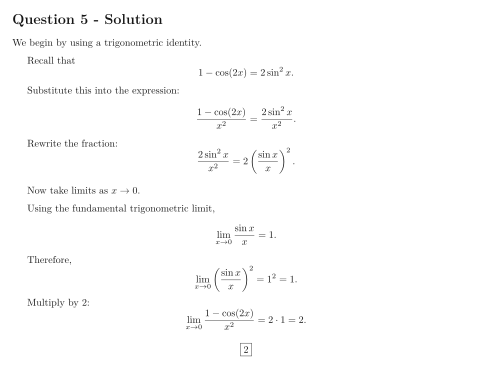
Question 5 Prove that limx→01−cos(2x)x2=2.\lim_{x\to 0}\frac{1-\cos(2x)}{x^2}=2. Show solutionHide solution+Question 5 - Solution We begin by using a trigonometric identity. Recall that 1−cos(2x)=2sin2x.1-\cos(2x)=2\sin^2 x. Substitute this into the expression: 1−cos(2x)x2=2sin2xx2.\frac{1-\cos(2x)}{x^2} = \frac{2\sin^2 x}{x^2}. Rewrite the fraction: 2sin2xx2=2(sinxx)2.\frac{2\sin^2 x}{x^2} = 2\left(\frac{\sin x}{x}\right)^2. Now take limits as x→0x\to 0. Using the fundamental trigonometric limit, limx→0sinxx=1.\lim_{x\to 0}\frac{\sin x}{x}=1. Therefore, limx→0(sinxx)2=12=1.\lim_{x\to 0}\left(\frac{\sin x}{x}\right)^2=1^2=1. Multiply by 22: limx→01−cos(2x)x2=2⋅1=2.\lim_{x\to 0}\frac{1-\cos(2x)}{x^2} = 2\cdot 1 = 2. 2\boxed{2}