Types of Infinity — Question 2

PDF ↗

Question 2

Prove that limx→∞xnex=0for any positive integer n.\lim_{x\to\infty}\frac{x^n}{e^x}=0 \quad\text{for any positive integer }n.

Original worksheet page 1: question and worked solution for 7-7-002
Show solutionHide solution

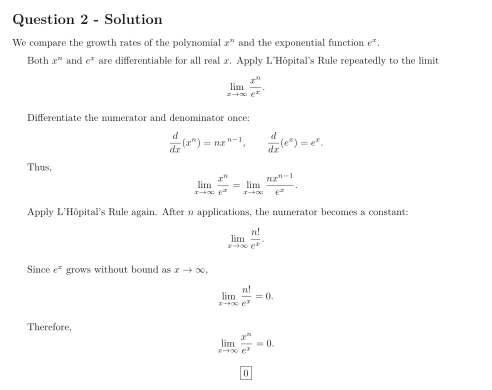
Question 2 - Solution

We compare the growth rates of the polynomial xnx^n and the exponential function exe^x.

Both xnx^n and exe^x are differentiable for all real xx. Apply L’Hôpital’s Rule repeatedly to the limit limx→∞xnex.\lim_{x\to\infty}\frac{x^n}{e^x}.

Differentiate the numerator and denominator once: ddx(xn)=nxn−1,ddx(ex)=ex.\frac{d}{dx}(x^n)=n x^{\,n-1}, \qquad \frac{d}{dx}(e^x)=e^x.

Thus, limx→∞xnex=limx→∞nxn−1ex.\lim_{x\to\infty}\frac{x^n}{e^x} = \lim_{x\to\infty}\frac{n x^{n-1}}{e^x}.

Apply L’Hôpital’s Rule again. After nn applications, the numerator becomes a constant: limx→∞n!ex.\lim_{x\to\infty}\frac{n!}{e^x}.

Since exe^x grows without bound as x→∞x\to\infty, limx→∞n!ex=0.\lim_{x\to\infty}\frac{n!}{e^x}=0.

Therefore, limx→∞xnex=0.\lim_{x\to\infty}\frac{x^n}{e^x}=0.

0\boxed{0}

Original worksheet page 2: question and worked solution for 7-7-002

Original worksheet layout. Use Enlarge or open the PDF for a closer view.