Question 1
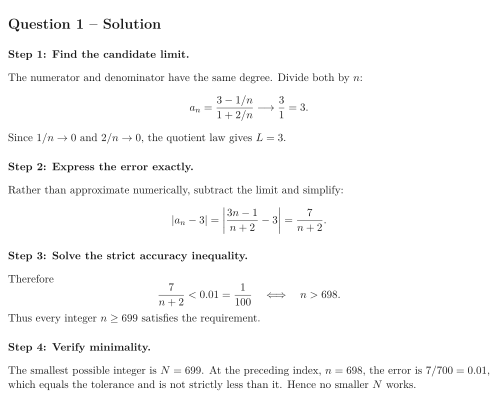
Let for .
Find .
Solve exactly and determine the smallest integer such that the inequality holds for every .
Show solutionHide solution
Question 1 – Solution
Step 1: Find the candidate limit.
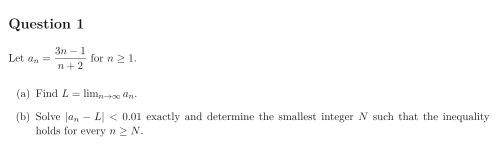
The numerator and denominator have the same degree. Divide both by : Since and , the quotient law gives .
Step 2: Express the error exactly.
Rather than approximate numerically, subtract the limit and simplify:
Step 3: Solve the strict accuracy inequality.
Therefore Thus every integer satisfies the requirement.
Step 4: Verify minimality.
The smallest possible integer is . At the preceding index, , the error is , which equals the tolerance and is not strictly less than it. Hence no smaller works.