Question 2
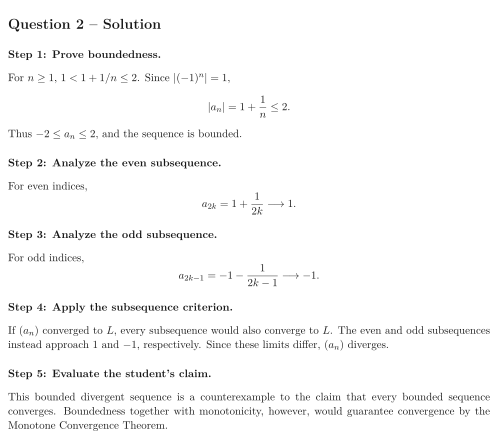
Let for .
Show that is bounded.
Find the limits of the even and odd subsequences and .
Use those limits to decide whether converges and to evaluate the claim, “Every bounded sequence converges.”
Show solutionHide solution
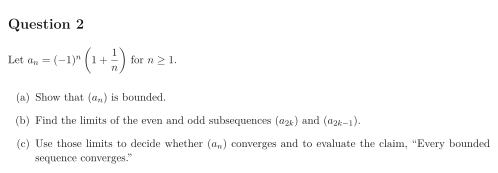
Question 2 – Solution
Step 1: Prove boundedness.
For , . Since , Thus , and the sequence is bounded.
Step 2: Analyze the even subsequence.
For even indices,
Step 3: Analyze the odd subsequence.
For odd indices,
Step 4: Apply the subsequence criterion.
If converged to , every subsequence would also converge to . The even and odd subsequences instead approach and , respectively. Since these limits differ, diverges.
Step 5: Evaluate the student’s claim.
This bounded divergent sequence is a counterexample to the claim that every bounded sequence converges. Boundedness together with monotonicity, however, would guarantee convergence by the Monotone Convergence Theorem.