Question 8
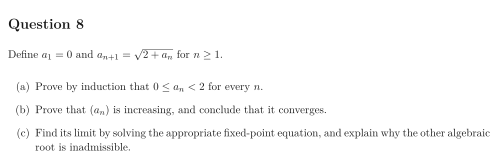
Define and for .
Prove by induction that for every .
Prove that is increasing, and conclude that it converges.
Find its limit by solving the appropriate fixed-point equation, and explain why the other algebraic root is inadmissible.
Show solutionHide solution
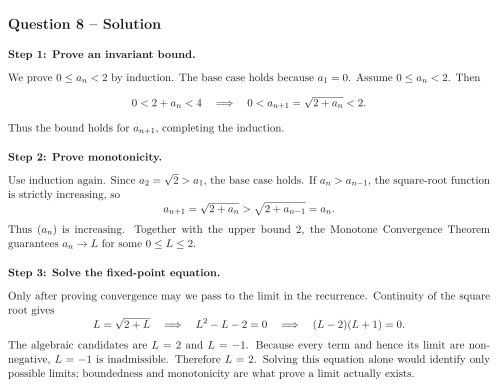
Question 8 – Solution
Step 1: Prove an invariant bound.
We prove by induction. The base case holds because . Assume . Then Thus the bound holds for , completing the induction.
Step 2: Prove monotonicity.
Use induction again. Since , the base case holds. If , the square-root function is strictly increasing, so Thus is increasing. Together with the upper bound , the Monotone Convergence Theorem guarantees for some .
Step 3: Solve the fixed-point equation.
Only after proving convergence may we pass to the limit in the recurrence. Continuity of the square root gives The algebraic candidates are and . Because every term and hence its limit are nonnegative, is inadmissible. Therefore . Solving this equation alone would identify only possible limits; boundedness and monotonicity are what prove a limit actually exists.