Ratio Test — Question 9

PDF ↗

Question 9

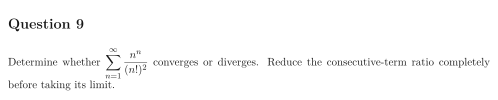
Determine whether ∑n=1∞nn(n!)2\displaystyle\sum_{n=1}^{\infty}\frac{n^n}{(n!)^2} converges or diverges. Reduce the consecutive-term ratio completely before taking its limit.

Original worksheet page 1: question and worked solution for 4-10-009
Show solutionHide solution

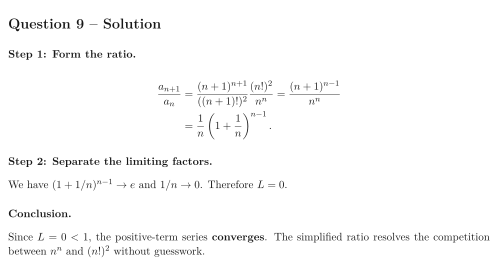
Question 9 – Solution

Step 1: Form the ratio.

an+1an=(n+1)n+1((n+1)!)2(n!)2nn=(n+1)n−1nn=1n(1+1n)n−1.\begin{align*} \frac{a_{n+1}}{a_n}&=\frac{(n+1)^{n+1}}{((n+1)!)^2}\frac{(n!)^2}{n^n}=\frac{(n+1)^{n-1}}{n^n}\\&=\frac1n\left(1+\frac1n\right)^{n-1}. \end{align*}

Step 2: Separate the limiting factors.

We have (1+1/n)n−1→e(1+1/n)^{n-1}\to e and 1/n→01/n\to0. Therefore L=0L=0.

Conclusion.

Since L=0<1L=0<1, the positive-term series converges. The simplified ratio resolves the competition between nnn^n and (n!)2(n!)^2 without guesswork.

Original worksheet page 2: question and worked solution for 4-10-009

Original worksheet layout. Use Enlarge or open the PDF for a closer view.