Ratio Test — Question 10

PDF ↗

Question 10

Use the Ratio Test to analyze ∑n=1∞(nn+1)n2\displaystyle\sum_{n=1}^{\infty}\left(\frac{n}{n+1}\right)^{n^2}. Use logarithms and a standard logarithmic expansion to evaluate the ratio limit.

Original worksheet page 1: question and worked solution for 4-10-010
Show solutionHide solution

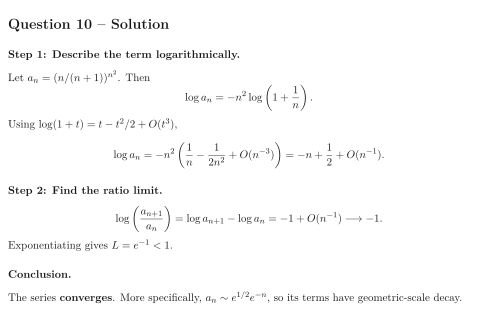
Question 10 – Solution

Step 1: Describe the term logarithmically.

Let an=(n/(n+1))n2a_n=(n/(n+1))^{n^2}. Then log⁡an=−n2log⁡(1+1n).\log a_n=-n^2\log\left(1+\frac1n\right). Using log⁡(1+t)=t−t2/2+O(t3)\log(1+t)=t-t^2/2+O(t^3), log⁡an=−n2(1n−12n2+O(n−3))=−n+12+O(n−1).\log a_n=-n^2\left(\frac1n-\frac1{2n^2}+O(n^{-3})\right)=-n+\frac12+O(n^{-1}).

Step 2: Find the ratio limit.

log⁡(an+1an)=log⁡an+1−log⁡an=−1+O(n−1)→−1.\log\left(\frac{a_{n+1}}{a_n}\right)=\log a_{n+1}-\log a_n=-1+O(n^{-1})\longrightarrow-1. Exponentiating gives L=e−1<1L=e^{-1}<1.

Conclusion.

The series converges. More specifically, an∼e1/2e−na_n\sim e^{1/2}e^{-n}, so its terms have geometric-scale decay.

Original worksheet page 2: question and worked solution for 4-10-010

Original worksheet layout. Use Enlarge or open the PDF for a closer view.