Question 5
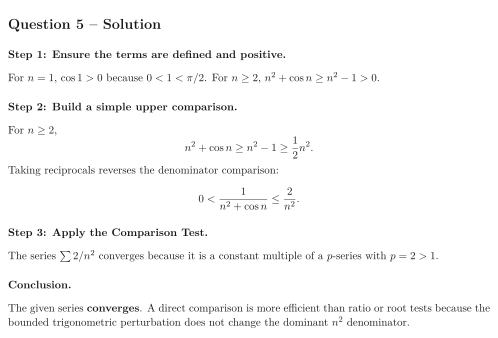
Determine whether converges. For the tail , use only the bound ; no exact trigonometric values are needed.
Show solutionHide solution
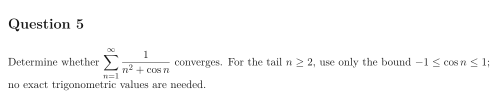
Question 5 – Solution
Step 1: Ensure the terms are defined and positive.
For , because . For , .
Step 2: Build a simple upper comparison.
For , Taking reciprocals reverses the denominator comparison:
Step 3: Apply the Comparison Test.
The series converges because it is a constant multiple of a -series with .
Conclusion.
The given series converges. A direct comparison is more efficient than ratio or root tests because the bounded trigonometric perturbation does not change the dominant denominator.