Strategy for Series — Question 6

PDF ↗

Question 6

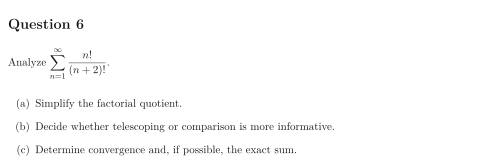
Analyze ∑n=1∞n!(n+2)!\displaystyle\sum_{n=1}^{\infty}\frac{n!}{(n+2)!}.

  1. Simplify the factorial quotient.

  2. Decide whether telescoping or comparison is more informative.

  3. Determine convergence and, if possible, the exact sum.

Original worksheet page 1: question and worked solution for 4-12-006
Show solutionHide solution

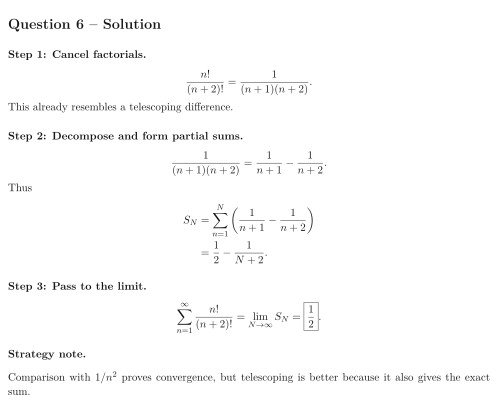
Question 6 – Solution

Step 1: Cancel factorials.

n!(n+2)!=1(n+1)(n+2).\frac{n!}{(n+2)!}=\frac1{(n+1)(n+2)}. This already resembles a telescoping difference.

Step 2: Decompose and form partial sums.

1(n+1)(n+2)=1n+1−1n+2.\frac1{(n+1)(n+2)}=\frac1{n+1}-\frac1{n+2}. Thus SN=∑n=1N(1n+1−1n+2)=12−1N+2.\begin{align*} S_N&=\sum_{n=1}^N\left(\frac1{n+1}-\frac1{n+2}\right)\\&=\frac12-\frac1{N+2}. \end{align*}

Step 3: Pass to the limit.

∑n=1∞n!(n+2)!=limN→∞SN=12.\sum_{n=1}^{\infty}\frac{n!}{(n+2)!}=\lim_{N\to\infty}S_N=\boxed{\frac12}.

Strategy note.

Comparison with 1/n21/n^2 proves convergence, but telescoping is better because it also gives the exact sum.

Original worksheet page 2: question and worked solution for 4-12-006

Original worksheet layout. Use Enlarge or open the PDF for a closer view.