Strategy for Series — Question 8

PDF ↗

Question 8

Determine whether ∑n=1∞(1+1n)−n2\displaystyle\sum_{n=1}^{\infty}\left(1+\frac1n\right)^{-n^2} converges. Explain why the Root Test is the natural first choice.

Original worksheet page 1: question and worked solution for 4-12-008
Show solutionHide solution

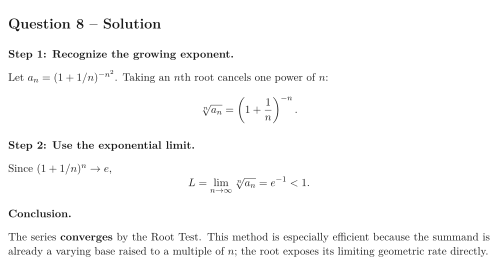
Question 8 – Solution

Step 1: Recognize the growing exponent.

Let an=(1+1/n)−n2a_n=(1+1/n)^{-n^2}. Taking an nnth root cancels one power of nn: ann=(1+1n)−n.\sqrt[n]{a_n}=\left(1+\frac1n\right)^{-n}.

Step 2: Use the exponential limit.

Since (1+1/n)n→e(1+1/n)^n\to e, L=limn→∞ann=e−1<1.L=\lim_{n\to\infty}\sqrt[n]{a_n}=e^{-1}<1.

Conclusion.

The series converges by the Root Test. This method is especially efficient because the summand is already a varying base raised to a multiple of nn; the root exposes its limiting geometric rate directly.
Original worksheet page 2: question and worked solution for 4-12-008

Original worksheet layout. Use Enlarge or open the PDF for a closer view.