Estimating the Value of a Series — Question 7
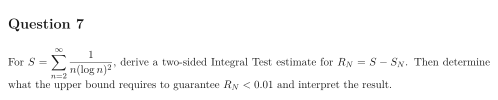
Question 7
For
,
derive a two-sided Integral Test estimate for
.
Then determine what the upper bound requires to guarantee
and interpret the result.
Show solutionHide solution+
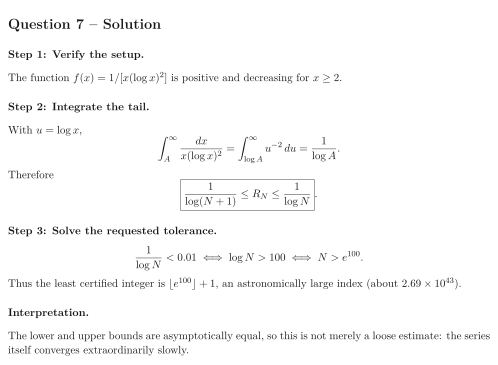
Question 7 –
Solution
Step 1: Verify the setup.
The function
is positive and decreasing for
.
Step 2: Integrate the tail.
With
,
Therefore
Step 3: Solve the
requested tolerance.
Thus the least certified integer is
,
an astronomically large index (about
).
Interpretation.
The lower and upper bounds are asymptotically equal, so this is not
merely a loose estimate: the series itself converges extraordinarily
slowly.
Original worksheet layout. Use Enlarge or open the PDF for a closer view.