Estimating the Value of a Series — Question 8

PDF ↗

Question 8

Let S=∑n=1∞ne−n\displaystyle S=\sum_{n=1}^{\infty}ne^{-n} and RN=∑n=N+1∞ne−nR_N=\sum_{n=N+1}^{\infty}ne^{-n}. Use the Integral Test remainder theorem to give a two-sided bound for RNR_N.

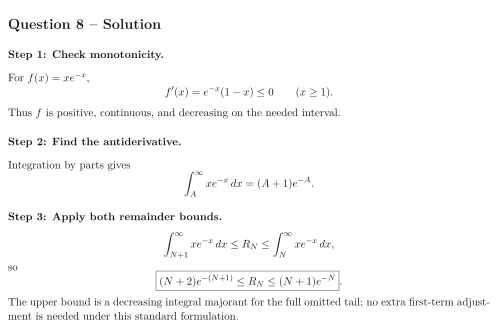
Original worksheet page 1: question and worked solution for 4-13-008
Show solutionHide solution

Question 8 – Solution

Step 1: Check monotonicity.

For f(x)=xe−xf(x)=xe^{-x}, f′(x)=e−x(1−x)≤0(x≥1).f'(x)=e^{-x}(1-x)\le0\qquad(x\ge1). Thus ff is positive, continuous, and decreasing on the needed interval.

Step 2: Find the antiderivative.

Integration by parts gives ∫A∞xe−xdx=(A+1)e−A.\int_A^{\infty}xe^{-x}\,dx=(A+1)e^{-A}.

Step 3: Apply both remainder bounds.

∫N+1∞xe−xdx≤RN≤∫N∞xe−xdx,\int_{N+1}^{\infty}xe^{-x}\,dx\le R_N\le\int_N^{\infty}xe^{-x}\,dx, so (N+2)e−(N+1)≤RN≤(N+1)e−N.\boxed{(N+2)e^{-(N+1)}\le R_N\le(N+1)e^{-N}}. The upper bound is a decreasing integral majorant for the full omitted tail; no extra first-term adjustment is needed under this standard formulation.

Original worksheet page 2: question and worked solution for 4-13-008

Original worksheet layout. Use Enlarge or open the PDF for a closer view.