Power Series and Functions — Question 3

PDF ↗

Question 3

Differentiate the geometric series term by term to find a power series for 1/(1−x)21/(1-x)^2. Reindex it in powers xnx^n and state its full interval of convergence.

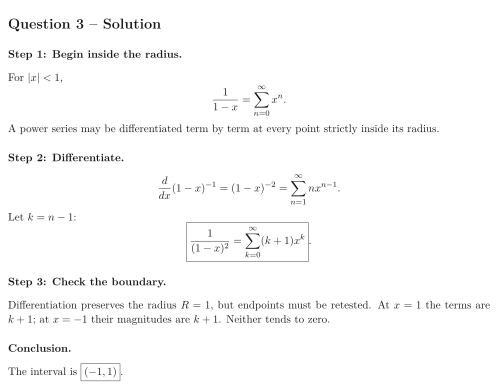
Original worksheet page 1: question and worked solution for 4-15-003
Show solutionHide solution

Question 3 – Solution

Step 1: Begin inside the radius.

For |x|<1|x|<1, 11−x=∑n=0∞xn.\frac1{1-x}=\sum_{n=0}^{\infty}x^n. A power series may be differentiated term by term at every point strictly inside its radius.

Step 2: Differentiate.

ddx(1−x)−1=(1−x)−2=∑n=1∞nxn−1.\frac{d}{dx}(1-x)^{-1}=(1-x)^{-2}=\sum_{n=1}^{\infty}n x^{n-1}. Let k=n−1k=n-1: 1(1−x)2=∑k=0∞(k+1)xk.\boxed{\frac1{(1-x)^2}=\sum_{k=0}^{\infty}(k+1)x^k}.

Step 3: Check the boundary.

Differentiation preserves the radius R=1R=1, but endpoints must be retested. At x=1x=1 the terms are k+1k+1; at x=−1x=-1 their magnitudes are k+1k+1. Neither tends to zero.

Conclusion.

The interval is (−1,1)\boxed{(-1,1)}.

Original worksheet page 2: question and worked solution for 4-15-003

Original worksheet layout. Use Enlarge or open the PDF for a closer view.