Power Series and Functions — Question 4
Question 4
Derive a power series for
by integrating a geometric series. Determine the constant of integration
and the exact interval of convergence.
Show solutionHide solution+
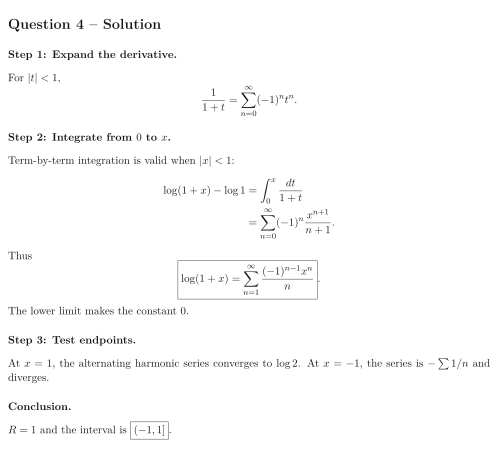
Question 4 –
Solution
Step 1: Expand the
derivative.
For
,
Step 2: Integrate from
to
.
Term-by-term integration is valid when
:
Thus
The lower limit makes the constant
.
Step 3: Test endpoints.
At
,
the alternating harmonic series converges to
.
At
,
the series is
and diverges.
Conclusion.
and the interval is
.
Original worksheet layout. Use Enlarge or open the PDF for a closer view.