Question 4
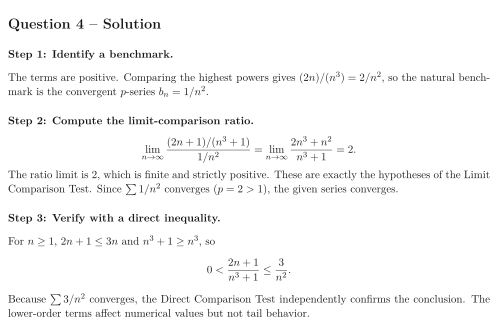
Determine whether converges or diverges.
Identify the reciprocal-power benchmark suggested by the leading terms.
Compute the limit-comparison ratio with that benchmark.
State the conclusion and give a direct upper comparison valid for .
Show solutionHide solution
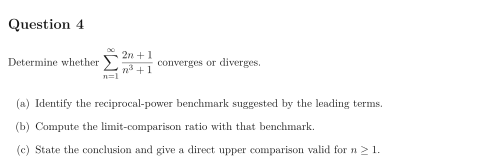
Question 4 – Solution
Step 1: Identify a benchmark.
The terms are positive. Comparing the highest powers gives , so the natural benchmark is the convergent -series .
Step 2: Compute the limit-comparison ratio.
The ratio limit is , which is finite and strictly positive. These are exactly the hypotheses of the Limit Comparison Test. Since converges (), the given series converges.
Step 3: Verify with a direct inequality.
For , and , so Because converges, the Direct Comparison Test independently confirms the conclusion. The lower-order terms affect numerical values but not tail behavior.