Question 3
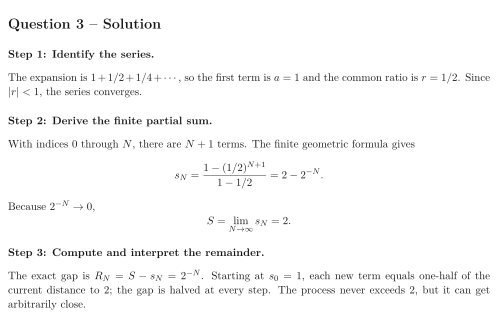
Consider .
Identify the geometric data and derive the th partial sum.
Find the sum and exact remainder.
Interpret the result as repeatedly adding half of the remaining distance to .
Show solutionHide solution
Question 3 – Solution
Step 1: Identify the series.
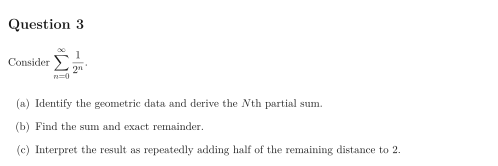
The expansion is , so the first term is and the common ratio is . Since , the series converges.
Step 2: Derive the finite partial sum.
With indices through , there are terms. The finite geometric formula gives Because ,
Step 3: Compute and interpret the remainder.
The exact gap is . Starting at , each new term equals one-half of the current distance to ; the gap is halved at every step. The process never exceeds , but it can get arbitrarily close.