Special Series — Question 4

PDF ↗

Question 4

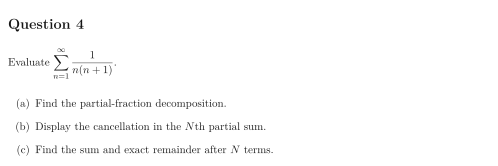
Evaluate ∑n=1∞1n(n+1)\displaystyle\sum_{n=1}^{\infty}\frac1{n(n+1)}.

  1. Find the partial-fraction decomposition.

  2. Display the cancellation in the NNth partial sum.

  3. Find the sum and exact remainder after NN terms.

Original worksheet page 1: question and worked solution for 4-5-004
Show solutionHide solution

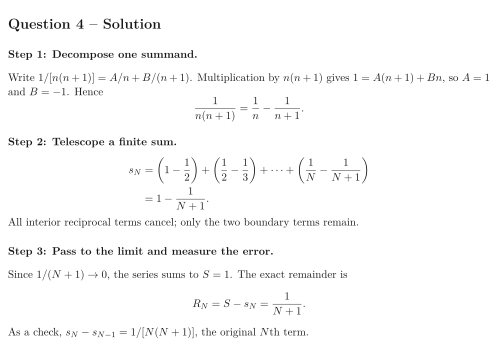
Question 4 – Solution

Step 1: Decompose one summand.

Write 1/[n(n+1)]=A/n+B/(n+1)1/[n(n+1)]=A/n+B/(n+1). Multiplication by n(n+1)n(n+1) gives 1=A(n+1)+Bn1=A(n+1)+Bn, so A=1A=1 and B=−1B=-1. Hence 1n(n+1)=1n−1n+1.\frac1{n(n+1)}=\frac1n-\frac1{n+1}.

Step 2: Telescope a finite sum.

sN=(1−12)+(12−13)+⋯+(1N−1N+1)=1−1N+1.\begin{aligned} s_N&=\left(1-\frac12\right)+\left(\frac12-\frac13\right) +\cdots+\left(\frac1N-\frac1{N+1}\right)\\ &=1-\frac1{N+1}. \end{aligned} All interior reciprocal terms cancel; only the two boundary terms remain.

Step 3: Pass to the limit and measure the error.

Since 1/(N+1)→01/(N+1)\to0, the series sums to S=1S=1. The exact remainder is RN=S−sN=1N+1.R_N=S-s_N=\frac1{N+1}. As a check, sN−sN−1=1/[N(N+1)]s_N-s_{N-1}=1/[N(N+1)], the original NNth term.

Original worksheet page 2: question and worked solution for 4-5-004

Original worksheet layout. Use Enlarge or open the PDF for a closer view.