Integral Test — Question 9

PDF ↗

Question 9

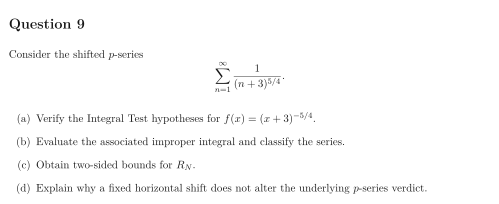
Consider the shifted pp-series ∑n=1∞1(n+3)5/4.\sum_{n=1}^{\infty}\frac1{(n+3)^{5/4}}.

  1. Verify the Integral Test hypotheses for f(x)=(x+3)−5/4f(x)=(x+3)^{-5/4}.

  2. Evaluate the associated improper integral and classify the series.

  3. Obtain two-sided bounds for RNR_N.

  4. Explain why a fixed horizontal shift does not alter the underlying pp-series verdict.

Original worksheet page 1: question and worked solution for 4-6-009
Show solutionHide solution

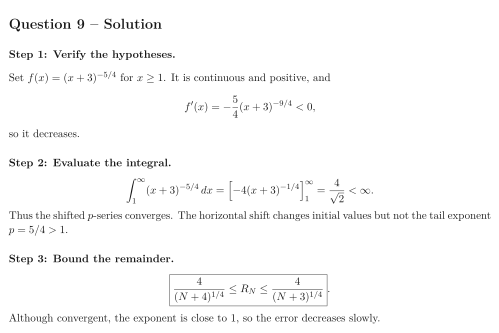
Question 9 – Solution

Step 1: Verify the hypotheses.

Set f(x)=(x+3)−5/4f(x)=(x+3)^{-5/4} for x≥1x\ge1. It is continuous and positive, and f′(x)=−54(x+3)−9/4<0,f'(x)=-\frac54(x+3)^{-9/4}<0, so it decreases.

Step 2: Evaluate the integral.

∫1∞(x+3)−5/4dx=[−4(x+3)−1/4]1∞=42<∞.\int_1^{\infty}(x+3)^{-5/4}\,dx =\left[-4(x+3)^{-1/4}\right]_1^{\infty}=\frac4{\sqrt2}<\infty. Thus the shifted pp-series converges. The horizontal shift changes initial values but not the tail exponent p=5/4>1p=5/4>1.

Step 3: Bound the remainder.

4(N+4)1/4≤RN≤4(N+3)1/4.\boxed{\frac4{(N+4)^{1/4}}\le R_N\le\frac4{(N+3)^{1/4}}}. Although convergent, the exponent is close to 11, so the error decreases slowly.

Original worksheet page 2: question and worked solution for 4-6-009

Original worksheet layout. Use Enlarge or open the PDF for a closer view.