Curvature — Question 9

PDF ↗

Question 9

A regular curve r→(t)\vec r(t) is enlarged by a factor c>0c>0 to form q→(t)=cr→(t)\vec q(t)=c\vec r(t). Prove that κq=κr/c\kappa_q=\kappa_r/c. What happens to the radius of curvature?

Original worksheet page 1: question and worked solution for 6-10-009
Show solutionHide solution

Question 9 – Solution

Strategy Track how first derivatives, second derivatives, cross products, and norms scale.

See the diagram in the original worksheet below.

Scaling q→′=cr→′,q→″=cr→″,∥q→′×q→″∥=c2∥r→′×r→″∥.\vec q'=c\vec r',\qquad \vec q''=c\vec r'',\qquad \|\vec q'\times\vec q''\|=c^2\|\vec r'\times\vec r''\|. Also ∥q→′∥3=c3∥r→′∥3\|\vec q'\|^3=c^3\|\vec r'\|^3. Hence κq=c2c3κr=κrc.\boxed{\kappa_q=\frac{c^2}{c^3}\kappa_r=\frac{\kappa_r}{c}}.

Radius Since ρ=1/κ\rho=1/\kappa, ρq=cρr\boxed{\rho_q=c\rho_r}. Enlargement makes every local osculating circle cc times larger and the curve correspondingly less sharply bent.
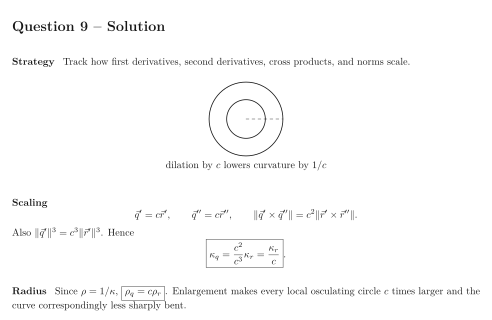
Original worksheet page 2: question and worked solution for 6-10-009

Original worksheet layout. Use Enlarge or open the PDF for a closer view.