Velocity and Acceleration — Question 9

PDF ↗

Question 9

Two particles move according to r→1(t)=⟨t,2t,0⟩\vec r_1(t)=\left\langle t,2t,0\right\rangle and r→2(t)=⟨4−t,1,2t⟩\vec r_2(t)=\left\langle 4-t,1,2t\right\rangle for t≥0t\ge 0. Find the time and value of their minimum separation.

Original worksheet page 1: question and worked solution for 6-11-009
Show solutionHide solution

Question 9 – Solution

Strategy Minimize squared distance; it has the same minimizer as distance and avoids a square root.

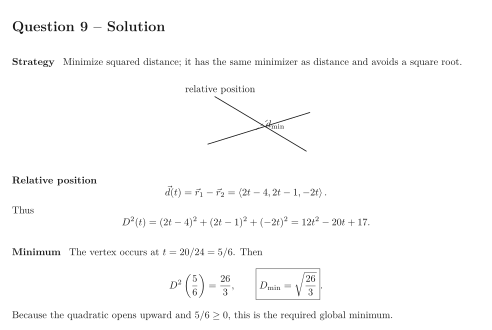
See the diagram in the original worksheet below.

Relative position d→(t)=r→1−r→2=⟨2t−4,2t−1,−2t⟩.\vec d(t)=\vec r_1-\vec r_2=\left\langle 2t-4,2t-1,-2t\right\rangle. Thus D2(t)=(2t−4)2+(2t−1)2+(−2t)2=12t2−20t+17.D^2(t)=(2t-4)^2+(2t-1)^2+(-2t)^2=12t^2-20t+17.

Minimum The vertex occurs at t=20/24=5/6t=20/24=5/6. Then D2(56)=263,Dmin=263.D^2\left(\frac 56\right)=\frac{26}{3}, \qquad \boxed{D_{\min}=\sqrt{\frac{26}{3}}}. Because the quadratic opens upward and 5/6≥05/6\ge 0, this is the required global minimum.

Original worksheet page 2: question and worked solution for 6-11-009

Original worksheet layout. Use Enlarge or open the PDF for a closer view.