Equations of Lines — Question 5

PDF ↗

Question 5

Find the line through P=(2,−1,4)P=(2,-1,4) whose direction is perpendicular to the directions of both lines L1:r→=⟨0,1,2⟩+s⟨1,2,−1⟩,L2:r→=⟨3,0,−1⟩+t⟨2,−1,1⟩.L_1:\vec r=\left\langle 0,1,2\right\rangle+s\left\langle 1,2,-1\right\rangle,\qquad L_2:\vec r=\left\langle 3,0,-1\right\rangle+t\left\langle 2,-1,1\right\rangle. Explain why exactly one such direction exists.
Original worksheet page 1: question and worked solution for 6-2-005
Show solutionHide solution

Question 5 – Solution

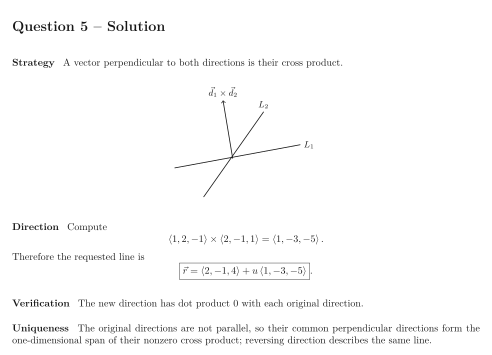
Strategy A vector perpendicular to both directions is their cross product.

See the diagram in the original worksheet below.

Direction Compute ⟨1,2,−1⟩×⟨2,−1,1⟩=⟨1,−3,−5⟩.\left\langle 1,2,-1\right\rangle\times\left\langle 2,-1,1\right\rangle=\left\langle 1,-3,-5\right\rangle. Therefore the requested line is r→=⟨2,−1,4⟩+u⟨1,−3,−5⟩.\boxed{\vec r=\left\langle 2,-1,4\right\rangle+u\left\langle 1,-3,-5\right\rangle}.

Verification The new direction has dot product 00 with each original direction.

Uniqueness The original directions are not parallel, so their common perpendicular directions form the one-dimensional span of their nonzero cross product; reversing direction describes the same line.
Original worksheet page 2: question and worked solution for 6-2-005

Original worksheet layout. Use Enlarge or open the PDF for a closer view.