Equations of Lines — Question 6

PDF ↗

Question 6

Find the shortest distance between the skew lines L1:r→=⟨0,0,0⟩+s⟨1,1,0⟩,L2:r→=⟨0,1,1⟩+t⟨1,−1,0⟩,L_1:\vec r=\left\langle 0,0,0\right\rangle+s\left\langle 1,1,0\right\rangle,\qquad L_2:\vec r=\left\langle 0,1,1\right\rangle+t\left\langle 1,-1,0\right\rangle, and identify the pair of closest points.
Original worksheet page 1: question and worked solution for 6-2-006
Show solutionHide solution

Question 6 – Solution

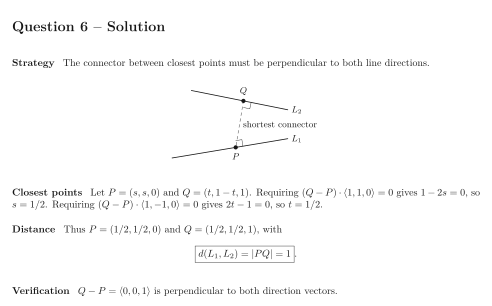
Strategy The connector between closest points must be perpendicular to both line directions.

See the diagram in the original worksheet below.

Closest points Let P=(s,s,0)P=(s,s,0) and Q=(t,1−t,1)Q=(t,1-t,1). Requiring (Q−P)⋅⟨1,1,0⟩=0(Q-P)\cdot\left\langle 1,1,0\right\rangle=0 gives 1−2s=01-2s=0, so s=1/2s=1/2. Requiring (Q−P)⋅⟨1,−1,0⟩=0(Q-P)\cdot\left\langle 1,-1,0\right\rangle=0 gives 2t−1=02t-1=0, so t=1/2t=1/2.

Distance Thus P=(1/2,1/2,0)P=(1/2,1/2,0) and Q=(1/2,1/2,1)Q=(1/2,1/2,1), with d(L1,L2)=|PQ|=1.\boxed{d(L_1,L_2)=|PQ|=1}.

Verification Q−P=⟨0,0,1⟩Q-P=\left\langle 0,0,1\right\rangle is perpendicular to both direction vectors.
Original worksheet page 2: question and worked solution for 6-2-006

Original worksheet layout. Use Enlarge or open the PDF for a closer view.