Question 4
Let be the set of points whose distance to the -plane is no greater than their distance to the -axis:
Tasks
Derive a Cartesian inequality describing .
Describe the boundary surface of .
Determine whether each test point belongs to :
Describe the reflectional and rotational symmetries of .
Show solutionHide solution
Question 4 – Solution
Strategy Translate each geometric distance into coordinates: distance to the -plane is , while distance to the -axis is the radial distance .
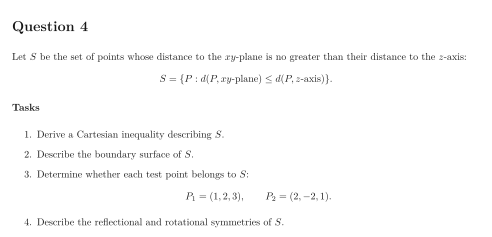
See the diagram in the original worksheet below.
Inequality and boundary We require The boundary is a double cone with vertex at the origin. The set is the region on or outside that cone in the radial direction.
Membership For , , so it is not in . For , , so it is in .
Symmetry and verification The inequality uses only squares, so changing any coordinate’s sign preserves membership; rotations about the -axis also preserve . On the -plane, every point satisfies it, while nonzero points on the -axis do not, matching the distance interpretation.